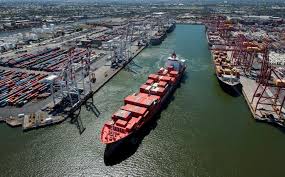
WASHINGTON: The sale price for the lease on the Port of Melbourne, Australia’s busiest container port, could be reduced by as much as $1 billion after doubts over a Chinese consortium’s ability to execute a successful bid and the withdrawal of one consortium because of regulatory concerns.
Infrastructure sources said that without a local partner the Chinese-backed bid — involving both Zhejiang Ports and the China Merchants Group — was likely to founder. It comes as the political compromise with the Coalition over the conditions of the lease is being blamed for the withdrawal of one of the main local consortiums, the Hastings Funds Management, Wren House and Alberta Investment Management Corporate bid. Victoria’s Andrews government has said it expects to get as much as $6bn from the sale, but without Chinese capital involved, and with the well-respected Hastings and its partners deciding conditions on the sale were too restrictive, it appears the sale price will suffer.

“There’s no doubt that that shitfight between Liberal and Labor has taken money off the table,’’ one source said, speculating that the effect on the price could be as much as $1bn. The source said the Chinese consortium had decided to go it alone without an Australian partner, which he warned would reduce its chances of success and may end up seeing it pull out.
China Merchants Group successfully clinched a $1.75bn investment in the Port of Newcastle, but it partnered with Hastings in that investment. While officially a state-owned enterprise, CMG is a comparatively sophisticated investor. It has a shareholding in Zhejiang Ports, which is a large port operator but has little experience investing abroad.
While the two Chinese players are being advised by CITIC CLSA’s Sydney office, they have so far not teamed up with an Australian superannuation fund or infrastructure player. Hastings and its partners — the Kuwait-backed Wren House Infrastructure and Canadian asset manager Alberta Investment Management Corporation — withdrew after telling lenders they held some concerns about the regulatory regime governing the sale.
That stems partly from the changes imposed at the behest of the state opposition, which delayed the sale until the government caved in on bringing forward the expiry of the compensation clause that the government said would maximise the value of the sale. Negotiations with the Coalition and pressure from users has also led to a comparatively heavy regulation of port charges that has caused Hastings to see the transaction in a different light.
That leaves the bid from the Macquarie Group-owned MIRA, IFM Investors and Dutch asset manager APG up against the bid from the Queensland Investment Corporation, Canada’s Borealis Infrastructure and financial investor Global Infrastructure Partners. A government source acknowledged the Chinese bid could struggle without a local partner and the Hastings bid withdrawal would hurt competition for the port, but said it would be unlikely to strip as much as $1bn off the price. Local partners in such big privatisations help placate regulators and politicians anxious about being seen as selling assets to offshore investors.
Scott Morrison and former treasurer Joe Hockey both blocked foreign takeovers — GrainCorp by Archer Daniels Midland and S. Kidman & Co to China’s Pengxin Group — while the sale of Darwin Port to China’s Landbridge provoked a political and defence controversy. The Department of Treasury and Finance, which is in charge of the sale of the lease, said it could not comment on the bids but the winner was scheduled to be announced by the end of the year.