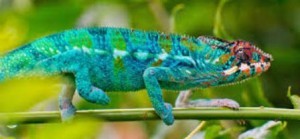


LONDON: The strange ability of chameleon to change its color has been a mystery from a very long time but now the secret behind it has been discovered. A study revealed that the chameleons are able to change colors quickly due to special cells present within their skin.
Researchers found that unlike creatures like octopus and squid, which change their color by changing their hues by building or breaking up pigments present in their skin cells, chameleons don’t do such things. As an alternative they rely on structural changes that changes the way the light reflects off their skin.
To carry out the study the researchers took four juvenile, four adult female, and five adult male panther chameleons, a species of chameleons which lives in Madagascar.
The scientists came to know that the chameleons have superposed thick layers of iridescent –iridophore cells which contain pigments and reflect light.
The researchers stated that the iridophore cells consist of nanocrystals of unlike shapes, sizes and organizations, which are main cause for color shifting in chameleons.
The chameleon’s skin excites and relaxes to modify the structural arrangement of the upper layer of cells which changes the skin’s color.
For example, a male chameleon on a branch is in a relaxed state but as he sees an opponent male he comes to an excited state.
Michel Milinkovitch, senior author of the study and professor of genetics and evolution at the Switzerland’s University of Geneva said, “When the skin is in the relaxed state, the nanocrystals in the iridophore cells are very close to each other — hence, the cells specifically reflect short wavelengths, such as blue.”
When the chameleon’s skin is excited the distance is increased between the near nanocrystals and the iridophore cell containing nanocrystals discriminatingly bounces off longer wavelengths like orange, red and yellow and Milinkovitch emailed Live Science, in which he stated, that chameleons aren’t blue always.

“Young entrepreneurs can reshape Pakistan’s economic future”
ISLAMABAD: The president of the Islamabad Chamber of Commerce and Industry has called for turning Pakistan's youth into a driver...