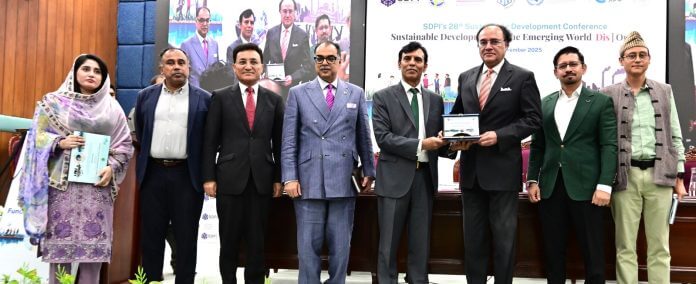
ISLAMABAD: Minister for Finance and Revenue, Senator Muhammad Aurangzeb emphasized the need for pragmatic, coordinated, and forward-looking approaches to climate finance and sustainable development.
While speaking at the 28th Sustainable Development Conference (SDC) organized by the Sustainable Development Policy Institute (SDPI), the minister noted that despite global uncertainty, the world economy continues to show remarkable resilience, driven by structural reforms, private sector dynamism and restrained protectionist policies.


He underlined that countries like Pakistan must continue to build strong fiscal and external buffers to manage potential external shocks amid rising protectionism and supply chain realignments.
Touching briefly on Pakistan’s emerging digital finance landscape, the minister referred to the creation of the Pakistan Crypto Council and the establishment of the Virtual Asset Regulatory Authority, which is being legislated through Parliament.
He reaffirmed that Pakistan’s approach to virtual assets and blockchain technology will remain firmly aligned with the country’s specific risk profile and regulatory priorities, including safeguards against capital flight, money laundering, and investor suitability.
Turning to the core theme of climate finance, Senator Aurangzeb highlighted Pakistan’s comprehensive framework that includes the National Adaptation Plan, Nationally Determined Contributions (NDCs), the Climate Prosperity Plan with the V-20, the Green Taxonomy issued by the State Bank, and the National Climate Finance Strategy rolled out in Baku last year.
He noted that while the global financing gap remains large, Pakistan already has sufficient resources and frameworks to begin effective implementation.
The minister informed that Pakistan has secured significant multilateral support, including $1.3 billion from the IMF under the Resilience and Sustainability Facility (RSF), $500 million from the Asian Development Bank, and a 10-year Country Partnership Framework with the World Bank Group worth $2 billion annually, focused primarily on climate change and population two existential challenges for Pakistan.
Senator Aurangzeb called for realism regarding global climate finance mechanisms, noting that funds such as the Green Climate Fund and Loss and Damage Fund remain limited and bureaucratic. He stressed that Pakistan must focus on mobilizing its own resources, private capital, and market-based mechanisms such as green bonds and carbon markets.
The minister also appreciated innovative private sector initiatives such as Acumen’s $90 million Climate Action Fund and Sindh’s pioneering mangrove carbon credit project, urging that these be replicated and scaled up nationwide.
He highlighted the growing potential for debt-for-nature swaps and called for enhanced technical capacity to design, structure, and monitor bankable, investable climate projects meeting international standards.
Senator Aurangzeb underscored the vital role of finance ministries in mainstreaming climate action, observing that if climate priorities are not integrated into national budgets, they cannot become national policy. He reaffirmed the government’s resolve to prioritize climate change and population management within Pakistan’s economic and fiscal planning.
The Minister urged collective ownership and coordination across all stakeholders, emphasizing that Pakistan must make the most of existing opportunities and resources before seeking new policy instruments. “We must take ownership, coordinate better, and move forward with urgency to address these existential issues,” he stated.
He thanked SDPI and its international partners for hosting the regional dialogue and reaffirmed the government’s commitment to pursuing sustainable, inclusive, and climate-resilient economic growth.