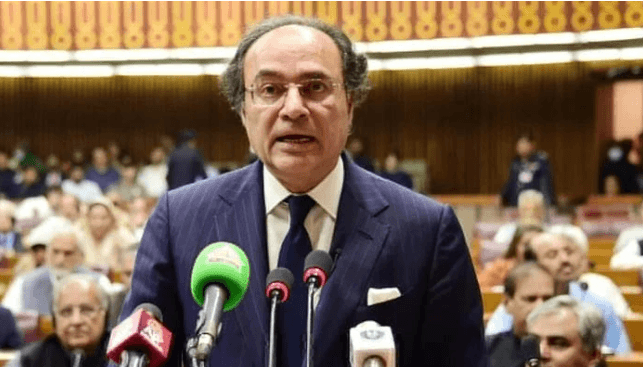
ISLAMABAD: Finance Minister Muhammad Aurangzeb presented the federal budget for fiscal year 2026-27 in the National Assembly during a session chaired by Speaker Ayaz Sadiq, as opposition members protested and created noise in the House.
The National Assembly budget session was chaired by Speaker Ayaz Sadiq.


Prime Minister Shehbaz Sharif reached the Assembly session, while Bilawal Bhutto Zardari also attended the proceedings. Earlier, Bilawal Bhutto and Mohsin Naqvi left for the National Assembly Hall.
Finance Minister Muhammad Aurangzeb formally presented the budget document for the new fiscal year 2026-27.
During his speech, the finance minister said Pakistan had gained such importance that its voice was now being heard. He also said that in May last year, Pakistan gave a befitting reply to India. Aurangzeb referenced Operation Bunyanun Marsoos during his budget speech and paid tribute to the services and sacrifices of Pakistan’s armed forces.
“It is an honour for me to present the budget before this House,” the finance minister said, while thanking the parliamentary leaders of all political parties for their cooperation.
He stated that today the entire world recognizes Pakistan’s defence capabilities and noted that several countries have expressed interest in acquiring Pakistani fighter jets for their armed forces.
Aurangzeb also highlighted the defence cooperation agreement between Pakistan and Saudi Arabia, saying it has provided a strong new foundation for bilateral relations. He added that Pakistan’s defence industry has emerged as a valuable source of foreign exchange earnings.
The minister said the armed forces gave a befitting response to the enemy and described the success of Operation Bunyanun Marsoos as a bright chapter in Pakistan’s history and an important milestone for the future. He stressed that a strong defence is essential for safeguarding the country’s sovereignty and integrity.
During the speech, opposition members raised slogans and displayed banners and placards in the House.
Aurangzeb said both the United States and Iran have placed their trust in Pakistan, adding that the improvement in Pakistan’s international standing is the result of efforts by the country’s civil and military leadership, to whom he expressed gratitude.
He said Pakistan played a responsible role in promoting peace in the region, with China supporting these efforts. According to the finance minister, Pakistan is working to ensure the success of diplomatic initiatives, while oil supplies through the Strait of Hormuz have been restored.
He added that Islamabad successfully helped bring the United States and Iran to the negotiating table through diplomatic engagement.
The finance minister thanked Prime Minister Shehbaz Sharif and PPP Chairman Bilawal Bhutto Zardari for their cooperation during the budget preparation process.
Economic performance and relief measures
Aurangzeb said Pakistan’s economic growth rate has reached 3.7% and credited the government’s economic management under Prime Minister Shehbaz Sharif for overcoming significant challenges.
He noted that the benefits of declining global oil prices are being passed on to the public. Despite the recent regional crisis, Pakistan faced no shortages of petroleum products, he said.
The government provided tax relief worth Rs128 billion through petroleum prices, according to the finance minister. He added that the government has absorbed the burden of price fluctuations to protect consumers.
He also pointed out that the US-Iran conflict had pushed petroleum prices higher in international markets.
Pakistan-China Relations
The finance minister said the prime minister’s recent visit to China gave fresh momentum to bilateral relations.
He emphasized that Pakistan-China ties extend beyond government-to-government relations, describing China as Pakistan’s most important trading partner and a key pillar of the country’s foreign policy.
Tax relief for salaried class
The government announced significant tax relief for salaried individuals.
The tax rate for individuals earning between Rs2.2 million and Rs3.2 million annually has been reduced from 23% to 20%.
The tax rate for those earning between Rs3.2 million and Rs4.1 million annually has been reduced from 30% to 25%.
The tax rate for individuals earning between Rs5.6 million and Rs7 million annually has been reduced from 35% to 32%.
The government has also decided to abolish the income surcharge imposed on the salaried class.
Super tax and property sector relief
The government announced the complete abolition of super tax across six income slabs.
Previously, individuals earning between Rs150 million and Rs500 million annually were subject to a super tax ranging from 1% to 7%. For incomes exceeding Rs500 million annually, the super tax rate has been reduced from 10% to 8%.
In addition, the government has reduced income tax and withholding tax on property transfers and announced incentives for the construction sector to encourage investment and growth.
Key tax telief and economic measures
The finance minister announced the abolition of taxes on essential women’s healthcare products as part of the government’s relief measures in Budget 2026-27.
Relief for foreign assets and international transactions
The government has abolished the Capital Value Tax (CVT) on foreign assets.
In addition, withholding tax on international transactions made through debit and credit cards has been significantly reduced. The tax rate on such transactions has been cut from 5% to 0.5%.
The finance minister said the new measures are aimed at encouraging Pakistanis to declare and bring their foreign financial assets into the formal economy.
Support for IT and export sectors
To promote the growth of Pakistan’s IT industry, the government has extended the concessionary tax rate of 0.25% on IT export earnings for another three years.
According to the budget speech, this relief will remain in place until June 30, 2029, and is expected to boost IT exports and strengthen the country’s digital economy. The government also announced additional relief measures for the export sector in the new budget.
Incentives for construction, allied industries
The finance minister said that around 40 industries linked to the construction sector, including cement, iron and steel, glass, timber, paints, tiles, and hardware, are expected to benefit from the new measures.
The government believes these incentives will stimulate construction activity, generate economic growth, and create employment opportunities across the country.
Property tax relief for filers
The government has announced a significant reduction in property transaction taxes for tax filers.
The tax rate on the sale of property for filers has been reduced from 5.5% to 2.75%.
The tax rate on the purchase of property for filers has been reduced from 2.5% to 1.25%.
These measures are intended to encourage investment in the real estate sector and promote documented economic activity.
Opposition protests during proceedings
Opposition members staged a protest inside the House during the budget presentation. The session witnessed noise and commotion as the finance minister presented the federal budget proposals.
Federal budget size fixed at Rs18.77tr
According to the budget document, the size of the federal budget for the upcoming fiscal year has been set at Rs18,771 billion. The Federal Board of Revenue’s annual tax target has been fixed at Rs15,264 billion.
Gross revenue has been estimated at Rs20,600 billion, while non-tax revenue is projected at Rs5,336 billion.
The budget document shows that Rs8,848 billion will be transferred to the provinces in the next fiscal year. After provincial transfers, the federal government’s net revenue is estimated at Rs11,751 billion.
The government plans to borrow Rs2,034 billion from internal sources and Rs813 billion from external sources. It will also obtain Rs4,012 billion through T-bills, Pakistan Investment Bonds and Sukuk.
In addition, Rs161 billion is expected to be generated through the privatization of government institutions during the next fiscal year.
FBR revenue targets
According to the budget documents, the FBR has been assigned a tax collection target of Rs15,264 billion for the fiscal year 2026-27.
The revenue targets have been divided as follows:
Income Tax Target: Rs7,613 billion
Indirect Taxes Target: Rs7,651 billion
Customs Duty Target: Rs1,651 billion
Sales Tax Target: Rs4,972 billion
Federal Excise Duty (FED) Target: Rs1,073 billion
Defence, development and current spending
The government has allocated Rs3,000 billion for defence in Budget 2026-27. A total of Rs1,000 billion has been earmarked for development projects.
The budget document shows that Rs17,495 billion will be spent on ongoing expenses in the next fiscal year.
Interest payments, pensions and civil govt
Debt servicing remains one of the largest expenditure heads, with Rs8,054 billion allocated for interest payments on loans. The government has allocated Rs1,169 billion for pension payments.
Another Rs1,071 billion has been set aside for running the civil government.
The federal budget also includes Rs430 billion for emergency measures in the new fiscal year. The allocation is expected to support the government’s response to urgent national needs during 2026-27.