


LONDON: This October, the must-see sky belongs to the morning, with four visible planets drawing closer together each day.
Solitary Saturn occupies the evening sky all alone this month. Look for the ringed planet low in the southwest as darkness falls, its yellowish-white hue piercing the thick atmosphere near the horizon. This month is your last good chance to see Saturn in the evening sky. Saturn sinks closer to the setting sun each evening and by month’s end, finally gives in to the sun’s might.
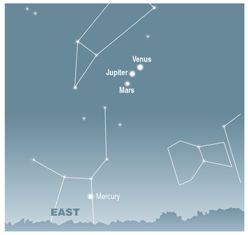
The other four visible planets, Mercury, Mars, Jupiter and Venus all congregate in the pre-dawn sky. The coming days provide a great opportunity to see planetary motion in action before sunrise. At month’s onset, to top the morning planet parade, look for Venus, brightest and highest in the eastern sky. Just below Venus and a little to the left you’ll find much fainter, but distinctly red Mars. Further down still is Jupiter, much brighter than Mars but fainter than Venus. Barely above the horizon, and very faint is the last of the morning planets, tiny Mercury.
As the month progresses Jupiter ascends toward Mars and Venus, setting up for several gorgeous conjunctions. The first conjunction happens on the morning of Oct 9 when a thin crescent moon joins the party and forms a striking triangle with Mars and Jupiter while Venus overlooks the trio from above.
Jupiter continues rising toward Mars and on Oct 17 and 18 these two neighbors appear closer together than the width of the full moon. During the following days, Jupiter slides past Mars, and rises toward Venus. On Oct 25 the two brightest planets stand side-by-side for another close conjunction. On Oct 28 Venus sinks a little toward Mars and with Jupiter up top, the three form a spectacular planetary triangle. All three planets are well above the horizon in the east by 5 a.m., so there is plenty of time to catch the action before sunrise.

Karachi Port sets 138-year cargo handling record
KARACHI: Pakistan's maritime sector has achieved a major milestone as Karachi Port set a new record in its 138-year history...


