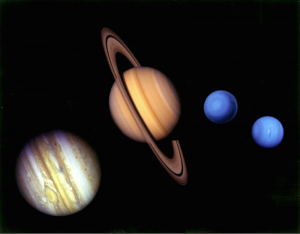
PARIS: Scientists have figured out that gas giants like Jupiter and Saturn started out as nothing more than tiny space rocks of about a foot round.
The formation of these large planets has always been something of a mystery, as existing planetary models don’t really give enough time for gas giants to come together.
You might also like


Observations of young star systems show that the gas discs that feed planetary formation usually only have a lifetime of around one to ten million years, giving a relatively short time frame for huge worlds like Jupiter and Saturn to grow.
In contrast, the Earth probably took at least 30 million years to form and may have taken as long as a hundred million years. So how in the Universe could Jupiter and Saturn have sprung up so quickly?