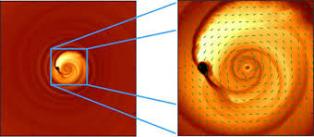


LONDON: Scientists at NASA say they’ve been investigating an odd, cyclic pattern of light coming from two distant black holes locked together in a complex gravitational dance that will likely see them eventually merge.
Researchers at the agency’s Jet Propulsion Laboratory in California say the “funky” light — their word — is some of the strongest evidence to date for the existence of such merging pairs of black holes.
Ground-based telescopes first detected the pair of black holes, together dubbed PG 1302-102, earlier in the year.
They’ve been confirmed as the tightest orbiting duo of black holes ever detected, separated by a distance not much more than the diameter of our own solar system.
That closeness suggests they’ll collide and then merge in around a million years — a brief interval in the cosmic scale of time — with a resulting huge blast throwing out the energy of 100 million supernovae, JPL researchers say.
The merging of giant black holes at the center of galaxies was a common event in the early ages of the universe, they say, but despite being common, they’ve proven difficult to detect and confirm.
Astronomers were led to PG 1302-102 by an unexpected light signal emanating from the center of a distant galaxy, found in data from NASA’s Galaxy Evolution Explorer (Galex) and confirmed by observations using the agency’s Hubble Space Telescope.

Karachi Port sets 138-year cargo handling record
KARACHI: Pakistan's maritime sector has achieved a major milestone as Karachi Port set a new record in its 138-year history...