
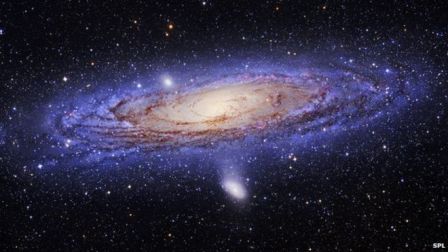


FRANCE: These galaxies are nearly as wide as our Milky Way Galaxy — about 60,000 light-years — yet harbor only 1 percent as many stars.
An international team of researchers led by Pieter van Dokkum at Yale University has used the W. M. Keck Observatory to confirm the existence of the most diffuse class of galaxies known in the universe. These “fluffiest galaxies” are nearly as wide as our Milky Way Galaxy — about 60,000 light-years — yet harbor only 1 percent as many stars.
“If the Milky Way is a sea of stars, then these newly discovered galaxies are like wisps of clouds,” said van Dokkum. “We are beginning to form some ideas about how they were born, and it’s remarkable they have survived at all. They are found in a dense, violent region of space filled with dark matter and galaxies whizzing around, so we think they must be cloaked in their own invisible dark matter ‘shields’ that are protecting them from this intergalactic assault.”
The team made the latest discovery by combining results from one of the world’s smallest telescopes as well as the largest telescope on Earth. The Dragonfly Telephoto Array used 14-centimeter state-of-the-art telephoto-lens cameras to produce digital images of the faint, diffuse objects. Keck Observatory’s 10-meter Keck I Telescope with its Low Resolution Imaging Spectrograph then separated the light of one of the objects into colors that diagnose its composition and distance.
Finding the distance was the clinching evidence. The data from Keck Observatory showed the diffuse “blobs” are large and far away, about 300 million light-years, rather than small and close by. The blobs can now safely be called Ultra Diffuse Galaxies (UDGs).

Karachi Port sets 138-year cargo handling record
KARACHI: Pakistan's maritime sector has achieved a major milestone as Karachi Port set a new record in its 138-year history...


