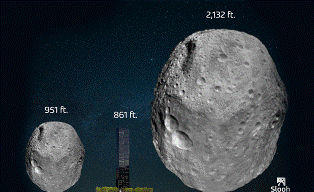
WASHINGTON: Halloween will be spookier than usual this year. It’s already a dark and sort of creepy time in the heavens, but arriving exactly on Halloween, a giant asteroid named Spooky will come fairly close to clobbering our planet.
Despite its large size and the fact that it will fly past the Earth at nearly the same distance as the Moon, Spooky was only discovered on October 10, a mere three weeks before its closest approach. Spooky will be closest on Halloween, and SLOOH will track it live, using our robotic telescopes in the Canary Islands and our global network of observatory partners.


The show will feature myself, SLOOH chief engineer Paul Cox and some special guests. I think that this live coverage will attract monstrous numbers of visitors, since we had over three million for our lunar eclipse show a few weeks ago. We will also discuss the dangers of “near-Earth asteroids,” the potential fallout of an asteroid this size impacting the Earth or Moon and will try to understand why it took so long to discover.
This asteroid is probably 32 times the size of the asteroid that injured a thousand people in Chelyabinsk, Siberia on February 15, 2013. If it were to impact us, the energy released would be measured not in kilotons like the Hiroshima atomic bomb, but in H-Bomb-type megatons.
Why else is this an eerie time? Well, this Halloween the Moon doesn’t rise until the action is over – at around 10 p.m. The Sun is setting earlier and earlier and it’s really getting dark. The leaves have dropped away, so barren branches now tremble in the wind. And yes, even that wind is stronger during our cold months.
It’s true: Autumn evokes melancholy autumn myths, thanks to November’s dying plants and diminished food. In our region, we now enter the cloudiest section of the year, further reducing the precious sunlight. Moreover, the season’s long nights epitomized darkness and mystery to primitive civilizations. It gave them an uneasy dread that went beyond their fear of nocturnal predators. Widespread cultures linked night with disaster. Even that word comes from the night sky: “dis” means bad; “aster” means star. Bad star.