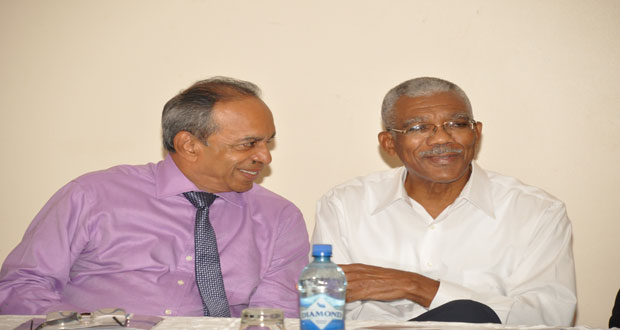
GEORGETOWN: The local private sector is yet to assume its role as the ultimate engine of economic growth in Guyana, as much of the nation’s economy is still driven by Government spending and initiatives.This was the reality conceded by Chairman of the Private Sector Commissioner (PSC), Ramesh Persaud, but a reality which Head of State President David Granger is looking to reverse, as he believes the private sector should be playing the lead role in terms of economic growth.
The Private Sector Commission held its long overdue 2014 Annual General Meeting (AGM) with President David Granger as the featured speaker, who updated local business chiefs and their representative body on his Guyana 20/20 vision—2015 to 2020, the natural life of the 11th Parliament, which he has since promised to neither prorogue or prematurely dissolve.


He firstly recognised the efforts of the PSC in recent years, particularly advocacy for the holding of Local Government Elections and efforts against the prorogation of Parliament, though to no avail.
The President spoke of his vision of a Guyana of strong institutions, such as a National Assembly, free from executive interference and an independent judiciary.
He told the PSC of his plans at having strong and efficient law enforcement and regulatory agencies as well as a highly educated work force.
According to President Granger, as part of his Guyana 20/20 plan, “I would like to see a reformed, refinanced University of Guyana so we can be proud of our graduates.”
The President lamented the fact that some corporations locally would have to actually train UG graduates.
Outlining his vision of an educated workforce meant to drive the private sector, he reminded of his proposed one laptop per teacher initiative.
The President said, laptops are in fact tools that should not be treated as toys to be given out like Christmas gifts.
“I see them as important tools in the economic development of this country, I see the internet, I see the information superhighway as being an entitlement of all Guyanese not a privilege of the few, of the rich, of an elite.”
The President made it clear Guyana will not anytime in its near future have a university campus in each of its ten regions and as such it is the internet that will have to be used to link students.
“The internet must link us, link our population, link our students together,” he told the PSC gathering.
Expanding on his vision for Guyana to the business community, the President said his Administration will be focusing heavily also on infrastructure given its direct correlation to Guyana’s development.
“Infrastructure is important in developing a country which is bigger than England and Scotland combined, we cannot develop our abundant resources, our natural resources without better infrastructure…“I would like to see an economic plan which makes better use of our resources,” according to President Granger.
The President used the opportunity to lament to the business leaders present the mass export of natural resources such as bauxite on large barges, when in fact; more manufacturing could have been taken on by Guyanese corporations.
“Just as we can welcome Americans and Brazilians and Canadians and Chinese and Russians to exploit our natural resources, we could have Guyanese opening big businesses, we could have Guyanese exploiting manganese and bauxite and timber as well.”
According to the President, villages in Guyana must also be seen as economic centres advocating a resuscitation of the village economy at the cottage level.
Turning his attention to ‘green energy’, the President said it is his belief that Guyana can achieve much more in this field.
The President said he does not envisage solar panels being distributed as gifts to hinterland residents at elections time, “little tokens and trinkets” as he put it.
Granger said it is his vision instead to see the realisation of solar panel farms generating electricity on a large scale.
The President said he envisions solar and hydro power lending to the development of the local manufacturing sector.
On the matter of hydro power, he said there are more than 100 potential sites that could generate hydro power.
He suggested a number of smaller hydro power plants at numerous locations as against the development of a single large facility, seen as some as the ‘proverbial silver bullet.’
According to President Granger, his vision for Guyana in the coming five years is a simple one, one devoid of plans to build any skyscrapers and five star hotels, “just a good life for all Guyanese.”
He said Government looks forward to the Private Sector led economic summit to be held in a matter of days and said, ‘I look to see that in the shortest possible time, that we all come together, politicians, business, trade unions, non-governmental organisations, religious organisations and hammer out a new social contract among Guyanese people taking us over the next five years.”
President Granger told the business leaders, “I see that much of the change that will take place in this country over the next five years will be led not by a state sector…we see the private sector fulfilling the obligation of developing private enterprise.”
The President’s remarks were preceded by the Private Sector Chairman, who, in delivering his annual report to the PSC, also used the occasion to call on the Administration to urgently address a number of critical concerns affecting the Private Sector.
He spoke to the need for faster more reliable internet service in Guyana, cheaper electricity, policies that promote fair play and equal opportunities, as well as a more efficient service being provided from the Public Sector.
Persaud also used the opportunity to welcome the recent passage of the amendments to the Anti-Money Laundering and Countering the Financing of Terrorism laws, failing which could have seen Guyana attracting possible economic sanctions which would have inherently adversely affected the local business community.
He recalled that in early 2014, immense efforts were expended on the part of the PSC to get the political parties to agree to the passage of the legislative amendments, “so that Guyana could be compliant to international standards.”
The PSC Chairman, as such, remarked positively on the passage of the legislation and used the opportunity to “urge the business community to ensure full adherence and we trust that Government would ensure the full operationalisation and implementation of this legislation.”