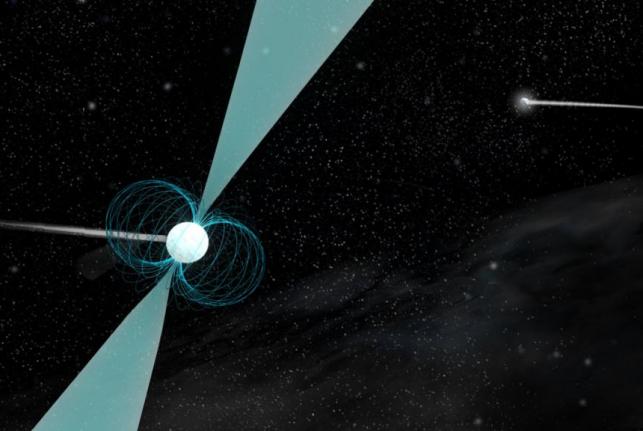
MORGANTOWN: A team of high school scientists have discovered an extremely rare pulsar, a neutron star that emits a high-powered beam of electromagnetic radiation.
Not only is the newly discovered star, called J1930-1852, part of a binary star system — an extremely rare double neutron system, no less — it also boasts the widest pulsar orbit ever recorded by astronomers.
You might also like


“Pulsars are some of the most extreme objects in the universe,” Joe Swiggum, a graduate student in physics and astronomy at West Virginia University who followed up on the students initial discovery, explained in a press release. “The students’ discovery shows one of these objects in a really unique set of circumstances.”
Swiggum is the lead author of a new paper on the pulsar; the study was recently accepted for publication in the Astrophysical Journal.
Pulsars form in the wake of the violent deaths experienced by massive stars. They are the product of supernovas. When the massive star explodes, the core is compressed and most of its energy is expelled. What remains is a dense ball of gas, with most its energy concentrated along the axis of its magnetic field.
The concentrated electromagnetic energy of pulsars shoot out lighthouse-like beams of radio waves. The waves pass through space as the collapsed neutron star rotates. These pulses of energy can be picked up by radio telescopes.
High school students discovered this particular pulsar while scanning data collected by the National Science Foundation’s Robert C. Byrd Green Bank Telescope, located in West Virginia.