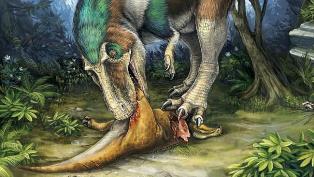
LONDON: A new study analyzing dinosaur jaw musculature found that this fearsome hunter that prowled North America about 150 million years ago was able to crank open its jaws between 79 and 92 degrees, wider than a right angle.
With a skull length of about 3 feet (90 cm), that means a jaw gape of more than 31 inches (80 cm), a terrifying threat to the plant-eating dinosaurs stalked by Allosaurus, a beast more than 33 feet (10 meters) long.


Its maximum jaw gape angle was larger than Tyrannosaurus rex, an even bigger carnivore that roamed North America about 66 million years ago and was certainly no slouch in this capability. T. rex was able to open its jaws an impressive 63.5 and 80 degrees.
“Swift ambush predators such as Allosaurus had the largest jaw gape among the studied dinosaur species, which is consistent with the requirement for a predator hunting larger prey,” said paleontologist Stephan Lautenschlager of Britain’s University of Bristol.
“Tyrannosaurus, in comparison, was able to exert continuous muscle force during different gape angles, which would be necessary for an animal biting through thick flesh and crushing bones.”
The study examined three species, meat-eaters Allosaurus fragilis, Tyrannosaurus rex and herbivore Erlikosaurus andrewsi. All belong to the group of two-legged dinosaurs called theropods.
Erlikosaurus was a strange pot-bellied dinosaur with scythe-like hand claws. It reached about 20 feet (6 meters) long and lived about 90 million years ago in Central Asia. Its maximum jaw gape reached 43.5 to 49 degrees.
Lautenschlager said Allosaurus and T. rex most likely used their maximum jaw gape only rarely, “probably only in cases when large prey had to be captured.” Their optimal gape angle was 28 degrees.