Customs Today
  • Home
  • Islamabad
  • Karachi
  • Lahore
  • National
  • Transfers and Postings
  • Chambers & Associations
  • Business
No Result
View All Result
Customs Today
  • Home
  • Islamabad
  • Karachi
  • Lahore
  • National
  • Transfers and Postings
  • Chambers & Associations
  • Business
No Result
View All Result
Customs Today
No Result
View All Result
Home Science & Technology Science

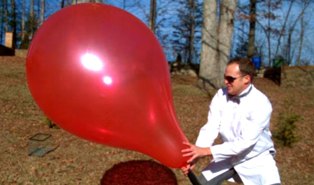
How does a balloon pop?

byCustoms Today Report
04/11/2015
in Science, Science & Technology
Share on FacebookShare on Twitter

PARIS: How did you do it? Did you poke it with a pin? Or did you overinflate it until it popped? Well, you probably did neither, because you don’t have any balloons (good for you; that’s normal), but if you had, the method you used would have dramatically changed what was actually happening with the balloon. Pop the balloon, and it splits into two pieces. Overinflate it, and it shatters into tiny fragments. Now, French physicists have explained why.

However, first, a demonstration. In this video from the Laboratoire de Physique Statistique, Parisian researchers Sébastien Moulinet and Mokhtar Adda-Bedia set up a simple protocol to film what happens when a balloon pops. In one clip, the balloon is pierced by a blade. In the other, it pops once it fills with too much air. They slowed down the tape to 1/2,000th of the usual speed and captured the rubber actually splitting into either two parts (with the blade) or several parts (with the overinflation).


You might also like

Tesla driverless system to use updated radar technology

12/09/2016

Apple to develop its own self-driving technology

10/09/2016

The physicists then published a paper in Physical Review Letters, in which they explained why these processes differ. In particular, they focused on the bursting model.

“We show that a dynamic instability drives this branching mechanism,” reads the study. “Fragmentation occurs when the crack tip speed attains a critical velocity for which tip splitting becomes the sole available mechanism of releasing the stored elastic energy.”

In other words, it all comes down to air pressure. By definition, a balloon that is punctured is less-inflated than a balloon that bursts (otherwise, the first balloon would have burst already). When the pin hits the balloon, the air sees a chance to escape and takes the quickest route: by forming a single crack. However, at the higher air pressure, the balloon must fraction into multiple cracks to get the air out.


Related Stories

Tesla driverless system to use updated radar technology

byCT Report
12/09/2016

WASHINGTON: Electric carmaker Tesla announced Sunday it was upgrading its Autopilot software to use more advanced radar technology. In a...

Apple to develop its own self-driving technology

byCT Report
10/09/2016

SAN FRANCISCO: Apple may not become an automaker, but it still wants to develop its own self-driving technology. The iPhone-maker's...

NASA spots slowest known magnetar

byCT Report
10/09/2016

WASHINGTON: Astronomers have found evidence of a magnetar - magnetised neutron star - that spins much slower than the slowest...

‘YouTubers’ outshining old-school television

byCT Report
09/08/2016

SAN FRANCISCO: A media revolution is taking place, and most people over 35 years of age aren’t tuned in. Millennial...

Next Post

JD.com files complaint against Alibaba for 'disrupting market order'

  • Terms and Conditions
  • Disclaimer

© 2011 Customs Today -World's first newspaper on customs. Customs Today.

No Result
View All Result
  • Transfers and Postings
  • Latest News
  • Karachi
  • Islamabad
  • Lahore
  • National
  • Chambers & Associations
  • Business
  • About Us

© 2011 Customs Today -World's first newspaper on customs. Customs Today.