Customs Today
  • Home
  • Islamabad
  • Karachi
  • Lahore
  • National
  • Transfers and Postings
  • Chambers & Associations
  • Business
No Result
View All Result
Customs Today
  • Home
  • Islamabad
  • Karachi
  • Lahore
  • National
  • Transfers and Postings
  • Chambers & Associations
  • Business
No Result
View All Result
Customs Today
No Result
View All Result
Home Science & Technology Science

How giraffes became the long-necked creatures as we know

bySana Anwar
26/11/2015
in Science, Science & Technology
Share on FacebookShare on Twitter

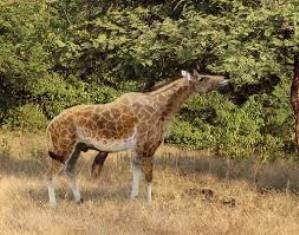
EUROPE: Reseachers from the New York Institute of Technology have finally reconstructed the fossilized neck of a Samotherium major—a genus of giraffe that is more or less its indirect predecessor—and in tandem have put together some key clues regarding how giraffes became the long-necked creatures as we now know them.

The NYIT research team concluded from its findings, which were published in a piece in the journal Royal Society Open Science, that the Samotherium was more or less a medial genus between the giraffe and the okapi, a member of the giraffid family who has a much shorter neck and lines that resemble the same patterning as a zebra.


You might also like

Tesla driverless system to use updated radar technology

12/09/2016

Apple to develop its own self-driving technology

10/09/2016

To do this, the scientists reconstructed what a Samotherium neck would have looked like from an array of fossils discovered on the Grecian island of Samos, which were then compared with the vertebrae of a modern-day okapi and giraffe, respectively. They found that the neck of the S. major was a scant meter, compared with that of the giraffe’s, which was around 2 meters, about 6.5 feet. When compared with the okapi, however, the neck proved to be longer than the okapi’s reconstructed vertebrae, which lent the team’s hypothesis some serious cred. They also noted several examples of vertebral changes, including the elongation of the back end of each of the neck bones as well as changes scientists had previously noted on the front of each bone.


Related Stories

Tesla driverless system to use updated radar technology

byCT Report
12/09/2016

WASHINGTON: Electric carmaker Tesla announced Sunday it was upgrading its Autopilot software to use more advanced radar technology. In a...

Apple to develop its own self-driving technology

byCT Report
10/09/2016

SAN FRANCISCO: Apple may not become an automaker, but it still wants to develop its own self-driving technology. The iPhone-maker's...

NASA spots slowest known magnetar

byCT Report
10/09/2016

WASHINGTON: Astronomers have found evidence of a magnetar - magnetised neutron star - that spins much slower than the slowest...

‘YouTubers’ outshining old-school television

byCT Report
09/08/2016

SAN FRANCISCO: A media revolution is taking place, and most people over 35 years of age aren’t tuned in. Millennial...

Next Post

Bermuda gov’t revenue rises 4.7% to $464.2m

  • Terms and Conditions
  • Disclaimer

© 2011 Customs Today -World's first newspaper on customs. Customs Today.

No Result
View All Result
  • Transfers and Postings
  • Latest News
  • Karachi
  • Islamabad
  • Lahore
  • National
  • Chambers & Associations
  • Business
  • About Us

© 2011 Customs Today -World's first newspaper on customs. Customs Today.