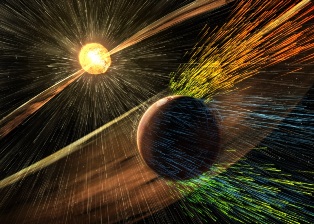
FRANCE: Mars may once have supported life but is now cold and dry, and scientists said Thursday that a stormy sun likely accelerated the loss of the Red Planet’s atmosphere.
In fact, researchers believe the thick, protective atmosphere that allowed ancient Mars to be warm and wet billions of years ago may have disappeared far earlier in its history than previously thought.


“Like the theft of a few coins from a cash register every day, the loss becomes significant over time,” said Bruce Jakosky, principal investigator on the MAVEN mission at the University of Colorado, Boulder.
“We’ve seen that the atmospheric erosion increases significantly during solar storms, so we think the loss rate was much higher billions of years ago when the sun was young and more active.”
Data from MAVEN, an unmanned spacecraft that has been circling Mars for the past year, was published in scientific studies, including four in the journal Science and 44 more in Geophysical Research Letters.
Instruments aboard the spacecraft are measuring ions in the upper atmosphere of Mars and are also keeping track of solar wind to help understand what influences the escape of gas to space.
“What we are finding is that the rate of loss out the top is relatively slow today, maybe only about 100 grams per second globally, but over time that can be a significant loss,” he said.
“And we think that that is the tip of the iceberg so to speak, that early in history the loss rates were much greater and that this mechanism could account for the loss of a very thick early atmosphere.”
MAVEN, which stands for Mars Atmosphere and Volatile Evolution, launched in 2013 and began orbiting the Red Planet in September 2014.
Its goal is to help scientists understand one of the solar system’s biggest mysteries — what happened to the water on Mars and the carbon dioxide in its atmosphere several billion years ago?
Mars today has a very thin atmosphere, less than one percent as thick as Earth’s.