Customs Today
  • Home
  • Islamabad
  • Karachi
  • Lahore
  • National
  • Transfers and Postings
  • Chambers & Associations
  • Business
No Result
View All Result
Customs Today
  • Home
  • Islamabad
  • Karachi
  • Lahore
  • National
  • Transfers and Postings
  • Chambers & Associations
  • Business
No Result
View All Result
Customs Today
No Result
View All Result
Home Science & Technology Science

Hubble finds a lonely galaxy

bySana Anwar
17/11/2015
in Science, Science & Technology
Share on FacebookShare on Twitter

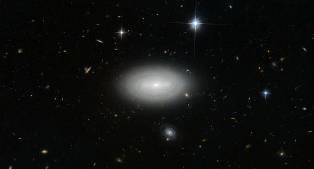
WASHINGTON: Only three local stars appear in this image, quartered by right-angled diffraction spikes. Everything besides them is a galaxy; floating like a swarm of microbes in a drop of water, and brought into view here not by a microscope, but by the Advanced Camera for Surveys on the Hubble Space Telescope.
In the foreground, the spiral arms of MCG+01-02-015 seem to wrap around one another, cocooning the galaxy. The scene suggests an abundance of galactic companionship for MCG+01-02-015, but this is a cruel trick of perspective. Instead, MCG+01-02-015’s unsentimental naming befits its position within the cosmos: it is a void galaxy, the loneliest of galaxies.

The vast majority of galaxies are strung out along galaxy filaments—thread-like formations that make up the large-scale structure of the universe—drawn together by the influence of gravity into sinuous threads weaving through space. Between these filaments stretch shallow but immense voids; the universe’s wastelands, where, outside of the extremely rare presence of a galaxy, there is very little matter—about one atom per cubic meter. One such desolate stretch of space is what MCG+01-02-015 reluctantly calls home.


You might also like

Tesla driverless system to use updated radar technology

12/09/2016

Apple to develop its own self-driving technology

10/09/2016

The galaxy is so isolated that if our galaxy, the Milky Way, were to be situated in the same way, we would not even have known of the existence of other galaxies until the development of strong telescopes and detectors in the 1960s.




Related Stories

Tesla driverless system to use updated radar technology

byCT Report
12/09/2016

WASHINGTON: Electric carmaker Tesla announced Sunday it was upgrading its Autopilot software to use more advanced radar technology. In a...

Apple to develop its own self-driving technology

byCT Report
10/09/2016

SAN FRANCISCO: Apple may not become an automaker, but it still wants to develop its own self-driving technology. The iPhone-maker's...

NASA spots slowest known magnetar

byCT Report
10/09/2016

WASHINGTON: Astronomers have found evidence of a magnetar - magnetised neutron star - that spins much slower than the slowest...

‘YouTubers’ outshining old-school television

byCT Report
09/08/2016

SAN FRANCISCO: A media revolution is taking place, and most people over 35 years of age aren’t tuned in. Millennial...

Next Post

Pink bollworm attacks cotton fields

  • Terms and Conditions
  • Disclaimer

© 2011 Customs Today -World's first newspaper on customs. Customs Today.

No Result
View All Result
  • Transfers and Postings
  • Latest News
  • Karachi
  • Islamabad
  • Lahore
  • National
  • Chambers & Associations
  • Business
  • About Us

© 2011 Customs Today -World's first newspaper on customs. Customs Today.