Customs Today
  • Home
  • Islamabad
  • Karachi
  • Lahore
  • National
  • Transfers and Postings
  • Chambers & Associations
  • Business
No Result
View All Result
Customs Today
  • Home
  • Islamabad
  • Karachi
  • Lahore
  • National
  • Transfers and Postings
  • Chambers & Associations
  • Business
No Result
View All Result
Customs Today
No Result
View All Result
Home Science & Technology Science

Hubble finds galaxies earliest stellar inhabitants from Milky Way’s heart

byCustoms Today Report
09/11/2015
in Science, Science & Technology
Share on FacebookShare on Twitter

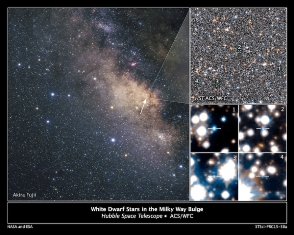
EUROPE: The Hubble telescope, gazing deep into the heart of the Milky Way galaxy, has discovered the fading remnants of some of the galaxy’s earliest stellar inhabitants.

In what astronomers are terming a “cosmic archaeological dig,” the space telescope has found evidence of how our home galaxy was constructed long before our sun and the Earth formed.


You might also like

Tesla driverless system to use updated radar technology

12/09/2016

Apple to develop its own self-driving technology

10/09/2016

Hubble has spotted a population of 70 ancient white dwarf stars, remains of a “homesteading” population of once-blazing pioneer stars in the giant central bulge sitting in the center of the Milky Way’s flat stellar disk.

White dwarfs are what are left of stars that shone brightly 12 million years ago in our galaxy’s groundbreaking years, astronomers say.

What Hubble sees supports the assumption that our galaxy’s central bulge was what came into existence first and formed its first stars very rapidly, taking less than two billion years, they say.

The pancake-shaped surrounding disk is full of later generations of stars that came into being at a more leisurely pace in the Milky Way’s “suburbs,” they explain.

“It is important to observe the Milky Way’s bulge because it is the only bulge we can study in detail,” says Annalisa Calamida at the Space Telescope Science Institute (STScI) in Baltimore, Md. “You can see bulges in distant galaxies, but you cannot resolve the very faint stars, such as the white dwarfs.”


Related Stories

Tesla driverless system to use updated radar technology

byCT Report
12/09/2016

WASHINGTON: Electric carmaker Tesla announced Sunday it was upgrading its Autopilot software to use more advanced radar technology. In a...

Apple to develop its own self-driving technology

byCT Report
10/09/2016

SAN FRANCISCO: Apple may not become an automaker, but it still wants to develop its own self-driving technology. The iPhone-maker's...

NASA spots slowest known magnetar

byCT Report
10/09/2016

WASHINGTON: Astronomers have found evidence of a magnetar - magnetised neutron star - that spins much slower than the slowest...

‘YouTubers’ outshining old-school television

byCT Report
09/08/2016

SAN FRANCISCO: A media revolution is taking place, and most people over 35 years of age aren’t tuned in. Millennial...

Next Post

China’s foreign trade drops in Oct

  • Terms and Conditions
  • Disclaimer

© 2011 Customs Today -World's first newspaper on customs. Customs Today.

No Result
View All Result
  • Transfers and Postings
  • Latest News
  • Karachi
  • Islamabad
  • Lahore
  • National
  • Chambers & Associations
  • Business
  • About Us

© 2011 Customs Today -World's first newspaper on customs. Customs Today.