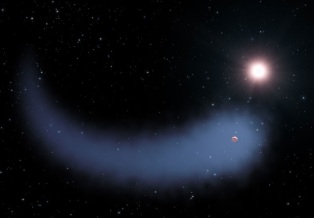


WASHINGTON: Hubble has found a large gas cloud near an exoplanet, which is 30 light years away from Earth. Astronomers were quite excited with the discovery as the gas cloud is quite huge, around 50 times the size of the parent star, GJ 436b.
Study’s main author David Ehrenreich said the cloud of hydrogen is evaporating, but at the moment, it is not posing any threat to the planet’s existence. Researchers said the red dwarf was even more aggressive in the past, which indicates that its atmosphere was evaporating at a faster rate than it is today.
The exoplanet could be having a mass, which could be 23 times heavier than that of the earth. The Neptune-sized planet is orbiting Gliese 436. As per the Hubble, the hydrogen cloud represents around 10% of GJ 436b’s original atmosphere.
Ehrenreich was of the view that the star was spotted in the ultraviolet spectrum. As per astronomers, it is the biggest cloud yet spotted and could help them understand the existence of hot super-earths.
Co-author of the study, Vincent Bourrier, said the comet-like tail also accompanies Gliese 436b. He termed that this discovery could prove as a game-changer for characterizing atmospheres of the whole population of Neptunes and Super-Earths in ultraviolet observations.
The astronomers in the study will continue to search for similar planets with comet-like tails. Researchers think there could be many more such planets waiting to be discovered.

Karachi Port sets 138-year cargo handling record
KARACHI: Pakistan's maritime sector has achieved a major milestone as Karachi Port set a new record in its 138-year history...