

Customs Today
  • Home
  • Islamabad
  • Karachi
  • Lahore
  • National
  • Transfers and Postings
  • Chambers & Associations
  • Business
No Result
View All Result
Customs Today
  • Home
  • Islamabad
  • Karachi
  • Lahore
  • National
  • Transfers and Postings
  • Chambers & Associations
  • Business
No Result
View All Result
Customs Today
No Result
View All Result
Home Science & Technology Science

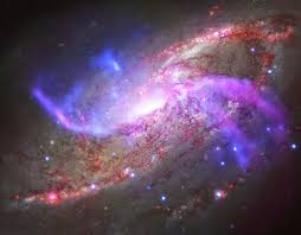
Hubble Space Telescope captured a stunning image of galaxy M63

byCustoms Today Report
16/09/2015
in Science, Science & Technology
Share on FacebookShare on Twitter

You might also like

Tesla driverless system to use updated radar technology

12/09/2016

Apple to develop its own self-driving technology

10/09/2016

NEW YORK: The Andromeda Galaxy isn’t the only one out there as the Hubble Space Telescope has lately captured a stunning image of M63, also called the Sunflower Galaxy. M63 was first discovered by French astronomer Pierre Mechain in 1779. In history, Mechain’s discovery has been etched in history as the 63rd entry into Charles Messier’s famous catalog.
The Messier catalog was made up of over 100 deep space objects, including diffuse nebulae, planetary nebulae, open clusters, globular clusters and galaxies.
As per NASA, M63 is present around 27 million light years away. The galaxy belongs to a larger group of galaxies called the M51 Group. It has been given name after its brightest galaxy, Messier 51 – also known as the Whirlpool Galaxy.
M63 can be called a flocculent galaxy its arms are patchy like tufts of cotton. Nearly, a third of all spirals are flocculent, and it seems that nobody so far has been able to understand what causes it.
One idea is that local gas clouds get stretched and sheared due to the galaxy’s differential rotation. This mean, stuff nearer to the center makes an orbit around the galactic center in less time as compared to stuff farther out.
The other idea is that formation of the star is localized, beginning randomly in spots in the disk of the galaxy, triggering more star formation around it leading to that patchwork. In galaxies such as the Milky Way, the spiral arms trigger star formation by themselves due to which more of a sweeping, grand design to the spiral arms is seen.

Related Stories

Tesla driverless system to use updated radar technology

byCT Report
12/09/2016

WASHINGTON: Electric carmaker Tesla announced Sunday it was upgrading its Autopilot software to use more advanced radar technology. In a...

Apple to develop its own self-driving technology

byCT Report
10/09/2016

SAN FRANCISCO: Apple may not become an automaker, but it still wants to develop its own self-driving technology. The iPhone-maker's...

NASA spots slowest known magnetar

byCT Report
10/09/2016

WASHINGTON: Astronomers have found evidence of a magnetar - magnetised neutron star - that spins much slower than the slowest...

‘YouTubers’ outshining old-school television

byCT Report
09/08/2016

SAN FRANCISCO: A media revolution is taking place, and most people over 35 years of age aren’t tuned in. Millennial...

Next Post

Kenya likely to produce 40,000MT of coffee in 2015

  • Terms and Conditions
  • Disclaimer

© 2011 Customs Today -World's first newspaper on customs. Customs Today.

No Result
View All Result
  • Transfers and Postings
  • Latest News
  • Karachi
  • Islamabad
  • Lahore
  • National
  • Chambers & Associations
  • Business
  • About Us

© 2011 Customs Today -World's first newspaper on customs. Customs Today.