Customs Today
  • Home
  • Islamabad
  • Karachi
  • Lahore
  • National
  • Transfers and Postings
  • Chambers & Associations
  • Business
No Result
View All Result
Customs Today
  • Home
  • Islamabad
  • Karachi
  • Lahore
  • National
  • Transfers and Postings
  • Chambers & Associations
  • Business
No Result
View All Result
Customs Today
No Result
View All Result
Home Science & Technology Science

Hubble Space Telescope Observes unique star dubbed “Nasty”

byCustoms Today Report
23/05/2015
in Science, Science & Technology
Share on FacebookShare on Twitter

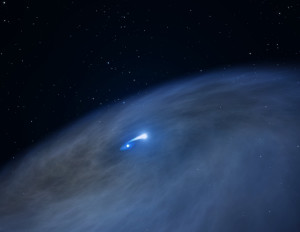
NEW YORK: Astronomers using the Hubble Space Telescope have found surprising new clues about a large, fast aging star that has never been seen before in the Milky Way galaxy.  In fact, the star is so different that astronomers have nicknamed it “Nasty 1,” a play on its catalog name of NaSt1.  This strange star may represent a brief transitory stage in the evolution of extremely massive stars.

The star was first discovered decades ago when it was identified as a Wolf-Rayet star, a rapidly evolving star that is more massive than the sun.  The star loses its hydrogen out layers quickly, exposing its super-hot and extremely bright helium burning core.  But Nasty 1 doesn’t look like a typical Wolf-Rayet star.

You might also like

Tesla driverless system to use updated radar technology

12/09/2016

Apple to develop its own self-driving technology

10/09/2016

“We were excited to see this disk-like structure because it may be evidence for a Wolf-Rayet star forming from a binary interaction,” said study leader Jon Mauerhan of the University of California, Berkeley. “There are very few examples in the galaxy of this process in action because this phase is short-lived, perhaps lasting only a hundred thousand years, while the timescale over which a resulting disk is visible could be only ten thousand years or less.”

In the research teams proposed scenario, the massive star evolves quickly but as it begins to run out of hydrogen, it swells.  This can happen much faster compared to the life of other stars and researchers estimate that Nasty 1 is only a few thousand years old and is located approximately 3,000 light years from Earth.

“We’re finding that it is hard to form all the Wolf-Rayet stars we observe by the traditional wind mechanism, because mass loss isn’t as strong as we used to think,” said Nathan Smith of the University of Arizona in Tucson, who is a co-author on the new NaSt1 paper. “Mass exchange in binary systems seems to be vital to account for Wolf-Rayet stars and the supernovae they make, and catching binary stars in this short-lived phase will help us understand this process.”


 

Related Stories

Tesla driverless system to use updated radar technology

byCT Report
12/09/2016

WASHINGTON: Electric carmaker Tesla announced Sunday it was upgrading its Autopilot software to use more advanced radar technology. In a...

Apple to develop its own self-driving technology

byCT Report
10/09/2016

SAN FRANCISCO: Apple may not become an automaker, but it still wants to develop its own self-driving technology. The iPhone-maker's...

NASA spots slowest known magnetar

byCT Report
10/09/2016

WASHINGTON: Astronomers have found evidence of a magnetar - magnetised neutron star - that spins much slower than the slowest...

‘YouTubers’ outshining old-school television

byCT Report
09/08/2016

SAN FRANCISCO: A media revolution is taking place, and most people over 35 years of age aren’t tuned in. Millennial...

Next Post

Indian court sentences 2 income tax officers in bribery case

  • Terms and Conditions
  • Disclaimer

© 2011 Customs Today -World's first newspaper on customs. Customs Today.

No Result
View All Result
  • Transfers and Postings
  • Latest News
  • Karachi
  • Islamabad
  • Lahore
  • National
  • Chambers & Associations
  • Business
  • About Us

© 2011 Customs Today -World's first newspaper on customs. Customs Today.