LONDON: Last month, Toyota sold its eight millionth hybrids since the first Prius went into showrooms in 1997, and spy pictures of the next Prius are circulating on the internet ahead of its official unveiling at Frankfurt in a fortnight.
The seven million mark was passed just 10 months ago, and Prius is one of 30 Toyotas now available with the technology. Other brands had to play catch-up, but they have. Prius now competes against scores of hybrids and Toyota is in danger of being left behind.
The next wave will focus on the plug-in variety that can travel commuter distances on battery power alone and be recharged at home. Premium makers, in particular, will roll out dozens of these in coming years, and the technology will be across entire vehicle ranges. Since 2012, the Prius also has been available as a plug-in hybrid in some markets.
Supply of alternative vehicles is one thing, demand for them another. While total sales of electric drivelines — hybrids, plug-in hybrids and pure electrics — are increasing, their share of the market is tiny. In Australia, just 1.15 per cent of new vehicles sold this year has some form of electric drive despite sales being up 7 per cent, a decline from the 1.27 per cent share electric drivelines had three years ago. It’s a similar picture in the US.
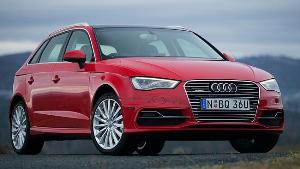
Audi’s first plug-in hybrid, the A3 e-tron, pictured below, has just gone on sale for $62,490, about $19,000 more than the equivalent A3 without the technology. You get an 110kW turbocharged, four-cylinder petrol engine teamed with a 75kW electric motor that can deliver up to 50km of pure battery-powered driving. When the batteries run out, the car reverts to more traditional hybrid operation, with the lead role played by the engine, giving a range up to 940km.
The A3 e-tron can be recharged in 2½ hours via a dedicated unit Audi installs as part of the price. In a deal with Origin, the first 10,000km of grid-charged electric driving will be offset by accredited renewable energy, and the recharging cost comes in as low as $1 a day. Its official consumption economy figure is an impressively low 1.6 litres per 100km, against 4.7l in its non-hybrid equivalent. It’s also more than half a second quicker to 100km/h, at 7.6 seconds, and better equipped.
Counting against it is 200kg in additional weight and just 280 litres of luggage space, down by 100 litres. On the basis of fuel savings alone, it would take decades to recoup the investment and the official figure looks a tad optimistic. On a 130km-drive from Bowral in the NSW southern highlands to Sydney, Column Shift used 2.1 litres but had to sacrifice air conditioning and travel at sub-legal speeds to achieve it.
Audi boss Andrew Doyle believes the A3 e-tron will attract 10 buyers a month and that its importance goes beyond sales alone. Audi expects 40 per cent of all new vehicles will have some form of electrification by 2030, with two-thirds using some form of hybrid. “We really think we have to stand out and be intelligent about the way we do it. A range of alternative drive-train solutions is a great way to do this,” Doyle says.
According to research from Roy Morgan, more families are choosing not to have a car. In the past four years, an additional 84,000 households became vehicle-less, increasing the total to 574,000 or 6.3 per cent overall. The trend is most marked among young couples, where one in nine now does without a car compared with one in 15 four years ago. But it’s reversed among older households, where almost 94 per cent has a car compared with 92.5 per cent. Young singles remain least likely to have a car while mid-life families are most likely. “Those most likely to be in the market for a new car are mid-life households that already have three or more cars in the driveway,” says Jordan Pakes at Roy Morgan.