

Customs Today
  • Home
  • Islamabad
  • Karachi
  • Lahore
  • National
  • Transfers and Postings
  • Chambers & Associations
  • Business
No Result
View All Result
Customs Today
  • Home
  • Islamabad
  • Karachi
  • Lahore
  • National
  • Transfers and Postings
  • Chambers & Associations
  • Business
No Result
View All Result
Customs Today
No Result
View All Result
Home Science & Technology Science

Impact glass on Mars may preserve signs of life from distant past

byCustoms Today Report
15/06/2015
in Science, Science & Technology
Share on FacebookShare on Twitter

You might also like

Tesla driverless system to use updated radar technology

12/09/2016

Apple to develop its own self-driving technology

10/09/2016

HONG KONG: In the search for past alien life on Mars, the discovery of impact glass on the surface of the planet may be the key to finally solving the mystery.
NASA’s Mars Reconnaissance Orbiter (MRO) detected deposits of glass in impact craters on Mars, deposits that might have been created when an asteroid hit the planet. On Earth, scientist Peter Schultz was able to show that bits of ancient flora were preserved inside impact glass that was formed millions of years ago. If life were present on Mars when an impact occurred, then they may have also been preserved in the glass.
With that in mind, researchers Kevin Cannon and Jack Mustard started looking for Martian impact glass, reporting their findings in the journal Geology.
“The work done by Pete and others showed us that glasses are potentially important for preserving biosignatures,” Cannon said. “Knowing that, we wanted to go look for them on Mars and that’s what we did here. Before this paper, no one had been able to definitively detect them on the surface.”
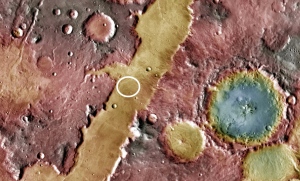
Cannon and Mustard were able to show that there were large impact glass deposits in several ancient Martian craters. One of the craters is near the Nili Fossae trough, a depression around 650 km long and one of the possible landing sites for NASA’s Mars 2020 rover.
Even before the detection of impact glass in the trough, Nili Fossae was already of interest because its crust is thought to date back to when Mars was much wetter. What seem to be ancient hydrothermal fractures—vents that could have provided energy for life—are also present in the region.

Related Stories

Tesla driverless system to use updated radar technology

byCT Report
12/09/2016

WASHINGTON: Electric carmaker Tesla announced Sunday it was upgrading its Autopilot software to use more advanced radar technology. In a...

Apple to develop its own self-driving technology

byCT Report
10/09/2016

SAN FRANCISCO: Apple may not become an automaker, but it still wants to develop its own self-driving technology. The iPhone-maker's...

NASA spots slowest known magnetar

byCT Report
10/09/2016

WASHINGTON: Astronomers have found evidence of a magnetar - magnetised neutron star - that spins much slower than the slowest...

‘YouTubers’ outshining old-school television

byCT Report
09/08/2016

SAN FRANCISCO: A media revolution is taking place, and most people over 35 years of age aren’t tuned in. Millennial...

Next Post

Hong Kong plans to allocate land for port expansion

  • Terms and Conditions
  • Disclaimer

© 2011 Customs Today -World's first newspaper on customs. Customs Today.

No Result
View All Result
  • Transfers and Postings
  • Latest News
  • Karachi
  • Islamabad
  • Lahore
  • National
  • Chambers & Associations
  • Business
  • About Us

© 2011 Customs Today -World's first newspaper on customs. Customs Today.