

Customs Today
  • Home
  • Islamabad
  • Karachi
  • Lahore
  • National
  • Transfers and Postings
  • Chambers & Associations
  • Business
No Result
View All Result
Customs Today
  • Home
  • Islamabad
  • Karachi
  • Lahore
  • National
  • Transfers and Postings
  • Chambers & Associations
  • Business
No Result
View All Result
Customs Today
No Result
View All Result
Home Uncategorized

Indian Ocean left holding 70% heat absorbed by Pacific thanks to the easterlies

byCustoms Today Report
21/05/2015
in Uncategorized
Share on FacebookShare on Twitter

You might also like

Pakistan to get $3b loan from Islamic Trade Financing Corporation

20/10/2024

Lahore I&I & Enforcement anti-smuggling operations achieve record success in early FY 2024-25

10/09/2024

NEW YORK: If you’re climate-curious, you’ve probably seen some of the research revealing why globally averaged surface air temperatures have warmed less quickly over the last decade or so than they did in the 1990s. The oceans are the dominant heat reservoir in the climate system, and they have been in a greedy phase lately, giving up a little less warmth to the atmosphere.
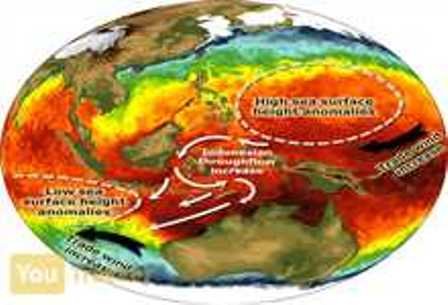
This has largely been the product of a string of La Niñas in the Pacific driven by stronger easterly trade winds. In those conditions, a pool of colder deep water takes the place of warmer surface water in the eastern Pacific. The warmer water that would normally be there is instead moved westward and mixed downward.
But here’s the puzzling thing: while records show a buildup of heat below the surface, the heat’s generally not in the Pacific. If that’s where so much downward mixing is taking place, where is the warm water going?
Using one dataset (a “reanalysis” that uses a model to generate global coverage from all the available measurements), over 70 percent of the heat accumulated in the upper 700 meters of the global ocean between 2003 and 2012 ended up in the Indian Ocean. Heat content in the Pacific, on the other hand, actually dropped a bit over that time period.
To find out why, a team led by University of Miami and NOAA researcher Sang-Ki Lee experimented with a global climate model. One configuration of the model was driven by the pattern of ocean surface heat exchange (determined by things like sunlight, water temperature, and air temperature) calculated by a historical reanalysis covering the last century. The model simulated the way the rest of the climate system responded to that two-way transfer of heat energy. For comparison, a second configuration of the model was driven by constantly average surface heat exchange.

Tags: Indian Ocean left holding 70% heatUniversity of Miami

Related Stories

Pakistan to get $3b loan from Islamic Trade Financing Corporation

byCT Report
20/10/2024

ISLAMABAD: Islamic Trade Financing Corporation (ITFC) to provide Pakistan with a $3 billion loan, according to an official statement released...

Lahore I&I & Enforcement anti-smuggling operations achieve record success in early FY 2024-25

byCT Report
10/09/2024

LAHORE:  Regional Directorate of Customs Intelligence & Investigation has demonstrated exceptional performance in the first two months of the fiscal...

ICCI and CDA to join hands for tree plantation drive in Capital

byQaisar Mansoor
09/08/2023

ISLAMABAD: Islamabad Chamber of Commerce and Industry (ICCI) in collaboration with the Capital Development Authority (CDA) would jointly launch a...

Customs Officials Yawar Abbas & Tariq Mehmood kidnapped in Karachi

byCT Report
08/07/2023

KARACHI: Customs Intelligence Officer Yawar Abbas and Customs Preventive Officer Tariq Mehmood who were working against smuggling were kidnapped by...

Next Post

Downloaded and installed WhatsApp, use this app for chat purposes

  • Terms and Conditions
  • Disclaimer

© 2011 Customs Today -World's first newspaper on customs. Customs Today.

No Result
View All Result
  • Transfers and Postings
  • Latest News
  • Karachi
  • Islamabad
  • Lahore
  • National
  • Chambers & Associations
  • Business
  • About Us

© 2011 Customs Today -World's first newspaper on customs. Customs Today.