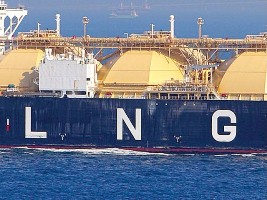
NEW DELHI: With liquified natural gas (LNG) prices hovering around a benign $5/mBtu for several months coupled with drop in domestic production of natural gas, India’s gas imports have risen a steep 45.4% annually in April. The LNG imports for the month of April stood at 2,142 million metric standard cubic metres (mmscm) compared with 1,473 mmscm in the corresponding month last year, according to petroleum ministry data. On the other hand, the gross gas production from domestic fields dropped 6.9% to 2,488 mmscm in April 2016 against the same month last year.
In the full year of 2015-16, the LNG imports witnessed a surge of 14.96% at 21,309.28 mmscm against 18,535.73 mmscm in FY15. The domestic natural gas output fell 5.5% in FY16 at 25,306.73 mmscm.


“Industrial and commercial segments are the largest consumers. With the expected pick-up of power generation and industrial manufacturing, imports are likely to grow further in FY17. Some new urea plants under implementation as well as some on the drawing board are likely to be drivers of incremental demand. Over the next five years, demand from city gas is also likely to grow faster than that of industrial segment and thus, its share in overall demand is expected to increase to double-digit figures,” said Kalpana Jain, senior director at Deloitte in India.
Imports of LNG have steadily risen over the years, albeit at varying rates of growth from about 7 bcm in FY06 to about 21 bcm now. Overall gas consumption, has increased, especially FY14 onwards, to compensate for the decline in domestic production. In March, gas volumes to the tune of 7.62 mmscmd have been auctioned to different stranded power stations to run operations.
“India’s total domestic production has been a sort of bell curve over the last 10 years,” explained Jain. The production was 32 billion cubic metres (bcm) in FY06, which increased to a high of 52 bcm in FY11 and thereafter reduced to about 32 bcm in FY16. While the overall production dropped, production of PSU explorers ONGC and OIL has largely remained flat in the range of 25-26 bcm. Production from private players, particularly RIL, ramped up from FY08 to FY11 and then declined substantially from FY12 onwards.
The flat production by PSUs is primarily because of two key factors—most of their producing fields are old and have crossed peak production stage and second, new discoveries are either yet to commence production or have not reached their full potential. “New fields being brought on production are not large enough to significantly offset the decline in production from older fields. Besides, some fields which are likely to be large reserves, such as ultra-deep water blocks in eastern coast, are in difficult to produce areas which probably require higher gas price to justify investment,” added Jain.
Indian domestic fields do not operate in a pattern where output could be ramped up immediately. Such production increase is possible on a short notice where output is varied based on global price and economics of fields as those in West Asia or Russia. Given that India is an import-dependent country, all developed and producing fields are in any case operated at optimal levels as regulated by the directorate general of hydrocarbons (DGH). The government’s efforts to spur investments in exploration and production is recent and given the long gestation of oil and gas investments, it could take time to bear fruit.