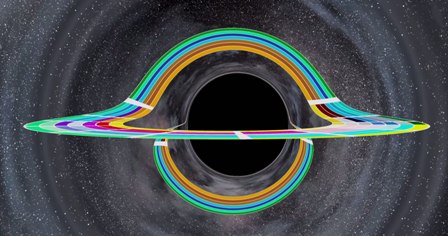


BRENT: For those who marvelled at the awe-inspiring, if perplexing, visuals of the spinning black hole in the movie Interstellar, there is another exciting piece of news. The team responsible for the visual effects has provided new insights into the physics of such objects.
In a paper published on February 13 in the journal Classical and Quantum Gravity, the team describes how the innovative computer code they used to generate images of the wormhole, black hole and other celestial objects has actually yielded a better understanding of “gravitational lensing” by spinning black holes.
Using their code, the team comprising London-based visual effects company Double Negative and Caltech theoretical physicist Kip Thorne figured out that when a camera was close up to a rapidly spinning black hole, special surfaces in space, known as caustics, created more than a dozen images of individual stars and of the thin, bright plane of the galaxy in which the black hole lived. They found that the images were concentrated along one edge of the black hole’s shadow.
These multiple images are caused by the black hole dragging space itself into a whirling motion and stretching the special surfaces (caustics) around itself many times.
This is the first time that the effects of caustics have been computed for a camera near a black hole, and the resulting images give some idea of what a person would see if they were orbiting around a black hole.
The computer code was used to create images of the movie’s wormhole and the black hole Gargantua and its glowing accretion disk, with unparalleled smoothness and clarity.

Karachi Port sets 138-year cargo handling record
KARACHI: Pakistan's maritime sector has achieved a major milestone as Karachi Port set a new record in its 138-year history...