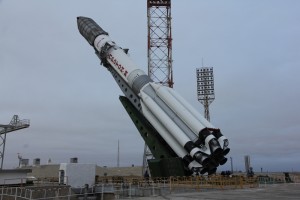
LONDON: International Launch Services (ILS) launched their Russian Proton-M rocket, this time carrying the MexSat-1 (Centenario) communications satellite for the Secretaria de Comunicaciones y Transportes (SCT) of Mexico on what was supposed to be a multi-hour flight to its transfer orbit. Launch from Pad 39 at the Baikonur Cosmodrome in Kazakhstan was nominal, before the mission suffered an apparent third stage failure.
The Proton booster that launched the Boeing-built has a heritage of over 400 launches since 1965 and is built by Khrunichev Research and State Production Center, one of the pillars of the global space industry and the majority owner of ILS.


The Proton’s first stage consists of a central tank containing the oxidizer surrounded by six outboard fuel tanks. Each fuel tank also carries one of the six RD-276 engines that provide first stage power. Total first stage vacuum-rated level thrust is 11.0 MN (2,500,000 lbf).
Of a conventional cylindrical design, the second stage is powered by three RD-0210 engines plus one RD-0211 engine and develops a vacuum thrust of 2.4 MN (540,000 lbf).
Powered by one RD-0213 engine, the third stage develops thrust of 583 kN (131,000 lbf), and a four-nozzle vernier engine that produces thrust of 31 kN (7,000 lbf). This is the stage that appears to have suffered the problem during Saturday’s launch.