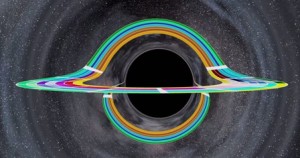


HONG KONG: “Interstellar” may have shown moviegoers an accurate view of what it is like to be near a black hole, but the film is now accompanied by a scientific paper on the mysterious objects. The film attempted to keep events as scientifically-accurate as possible, and even NASA took part in promotion of the movie.
Movie makers who worked on special effects on the film admit that a fully-accurate depiction of a black hole would have been too confusing for most audiences. Therefore, they “toned down” some of the science in the film.
Physicist Kip Thorne, who also participated in the Carl Sagan movie “Contact”, first proposed the idea of creating a realistic film about black holes. The scientist collaborated with Double Negative, a visual effects company in London, as well as director and writer Christopher Nolan to develop the project.
“I’d ask him a question and maybe a week later, sometimes a month, I’d get a beautifully presented paper that he’d laid out with references going into the history of the problems I’d been asking about,” Oliver James, chief scientist of Double Negative, said.
Gargantua, the massive black hole at the center of the story, is shown as a massive accretion disk, where matter spirals into the object, emitting radiation as it comes inward. In early filming, the black hole was shown slightly squashed, due to the effects of rotation. However, that was thought to be confusing to audiences, so the effect was negated in the film. In the movie, the accretion disk surrounding Gargantua is shown larger and more red than it would be in real life. Also, the Doppler shift in light would cause half of a rotating disk to appear blue to an observer, and that effect was also taken out of the final film.
Bundles of light rays were displayed in images, rather than individual paths, in order to make the film more enjoyable for moviegoers. Computers were used to simulate the actions of light passing near such a massive body, and the results of that process helped astronomers examine what would actually happen in real life, under those conditions.

Karachi Port sets 138-year cargo handling record
KARACHI: Pakistan's maritime sector has achieved a major milestone as Karachi Port set a new record in its 138-year history...