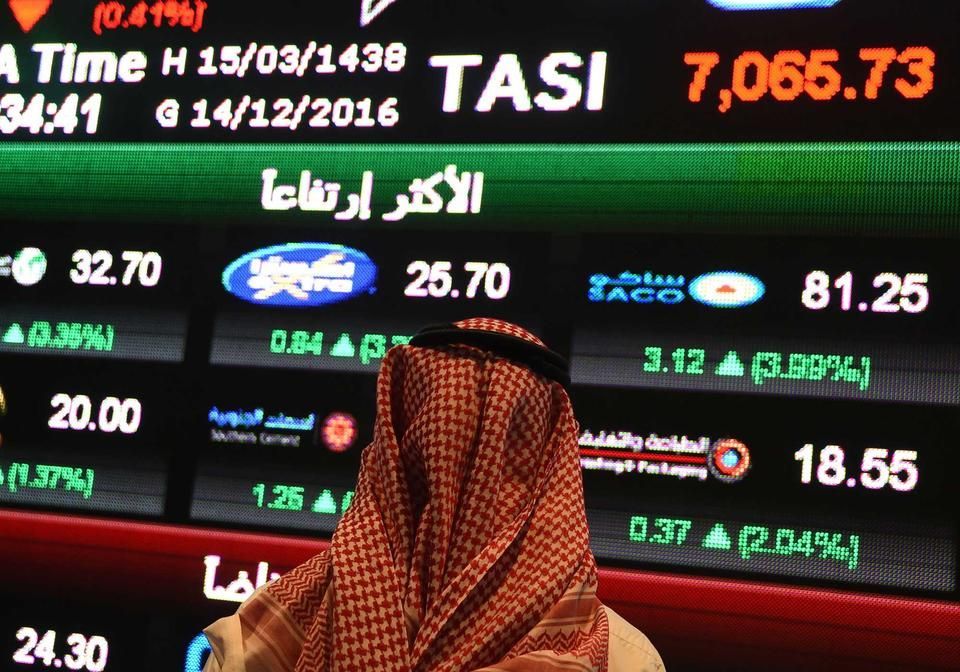
Investors are starting to tune out the noise of the billions of dollars that flowed into Saudi bonds and stocks in the first half of the year after the kingdom’s upgrade to emerging-market status.
While the Saudi government has accelerated the pace of deregulating its capital markets, concerns about the economy’s reliance on oil and escalating tensions in the Arabian Gulf are coming back to the fore.

The bulk of the estimated $20 billion in inflows from Saudi Arabia’s ascension to two key developing-nation equity indexes would materialise by end-August, according to EFG-Hermes.
Meanwhile, the tailwind from its dollar bonds’ inclusion in JPMorgan Chase & Co.’s emerging-market gauges, happening gradually over nine months through September, has largely played out, said Arqaam Capital’s Abdul Kadir Hussain.
“Once the passive flows subside, courting active investors will be a hard grind,” said M.R. Raghu, the head of research at Kuwait Financial Centre SAK, which manages $3.8 billion. “Foreign investors will perceive Saudi Arabia as a commodity play for some time to come.”
Active money managers seek to outperform benchmark indexes by buying and selling securities. By contrast, passive funds track an index.
Saudi stocks are also getting more expensive relative to developing-nation equities, with the gap in their estimated price-to-earnings ratios near the widest since 2015. The high valuations are the reason Mark Mobius, a pioneer in emerging-market investing, isn’t joining the party.
What’s more, some investors aren’t ready to forgive or forget the murder of columnist Jamal Khashoggi in the Saudi consulate in Istanbul in October.
“The Khashoggi incident and the general structure of the rule of law in Saudi Arabia will continue to deter some investors,” said Mobius, who spent three decades at Franklin Templeton Investments before setting up his own firm last year.
No limit
The prospects may not improve much despite regulatory changes in June that are paving the way for foreigners to take controlling stakes in sectors from banking to petrochemicals after Saudi Arabia removed a cap on ownership of publicly traded companies for international strategic investor.
Although foreign direct investment more than doubled last year to $3.2 billion, it remains well below the average level of the past decade.
“Higher valuations are to some extent justified by the earnings outlook and technicals,” said Michael Bolliger, the Zurich-based head of emerging-market asset allocation at UBS Wealth Management’s chief investment office. “But for this to be sustained, it is crucial that the government keeps up the reform pace and successfully cooperates with the private sector.”
Saudi Arabia’s bonds have a market value of about $42 billion in JPMorgan’s emerging-market indexes, according to calculations by Arqaam Capital.
The debt might be vulnerable to increased swings in US Treasury yields and concerns over global trade tensions and slowing global economic growth in the coming months, said Hussain, the Dubai-based head of fixed-income asset management at Arqaam Capital.
The securities have returned more than 11% this year, outperforming the 9.6% gain in emerging markets, according to Bloomberg Barclays indexes.
“Risks for the second half are fairly elevated overall,” he said. “We have already had a strong rally in the first six months.”