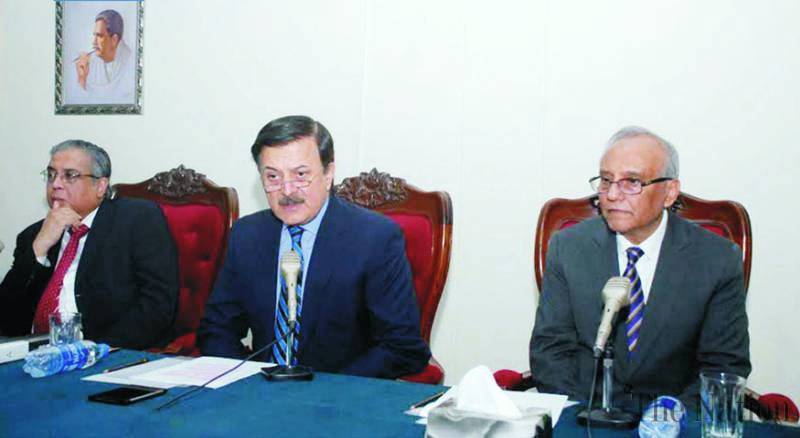
ISLAMABAD: Former Finance Minister Hafiz Pasha and Institute for Policy Reforms (IPR) Managing Director Dr Hafiz Pasha, while releasing Budget Strategy Paper for 2015-16, has urged the government to switch from stabilisation policy to revival of the economy, by taking measures to raise GDP growth rate to 5.5 percent in the upcoming financial year.
He said that the fiscal year 2015-16 will be the turning point, as the government in first two years engaged in the process of stabilising the economy and it achieved some successes. Now, the time has come to switch from a policy of stabilisation to revival of the economy, he added.


Dr Pasha said that fortunately, both the external and internal environments have become more conducive for taking the economy to a higher growth trajectory. He added that with a certificate of good health from the IMF, following the build up to foreign exchange reserves to almost $13 billion and the fall in rate of inflation to below 5pc, the government is in a position to adopt a policy of revival.
The IPR suggested that Annual Plan 2015-16 must target for a growth rate of about 5.5 percent for next fiscal year. “The 2015-16 budget ought to be a ‘tax free’ budget. No tax rates should be enhanced unlike the last two years. FBR should focus on broadening the tax base (details are given later) and on improvements in tax administration”, an independent and non-partisan think-tank demanded of the government in its proposals.
Talking about the Chinese investment worth of $46 billion, Dr Pasha said that it is essential that about Rs200billion to Rs250 billion be allocated for CPEC projects in 2014-15 in the Federal PSDP. Therefore, the size of the Public Sector Development Programme should enhance by Rs500 billion to Rs 1425 billion for the next fiscal year.
On the direction of the International Monetary Fund (IMF), Pakistan had reduced the PSDP volume by Rs 300 billion to Rs 925 billion from the budgetary target of Rs 1225 billion, he added.
The IPR recommended the government to keep the budget deficit target at 6.5 percent of the GDP for the next financial year, which it estimates to remain at 5.5 percent of the GDP by the end of present fiscal year.
Speaking on the occasion, Humayun Akhtar Khan, Chairman IPR stated that weak economic performance of recent years had increased the burden on the people. It is important to look at the economy’s growth potential rather than focus on the limited criteria of reduced fiscal deficit and increase in forex reserves.
High cost external borrowings have increased foreign reserves. It is moot if such levels of indebtedness are sustainable for the economy. Before long, debt servicing will begin, which will add significantly to government expenditure and to fiscal deficit. Fiscal deficit would increase also if government settles outstanding circular debt, which has accumulated to over Rs500 billion.