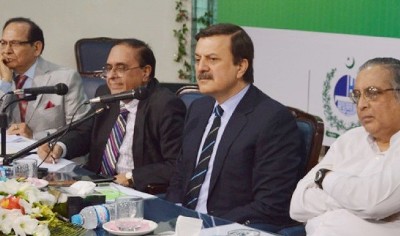
ISLAMABAD: The Institute for Policy Reforms (IPR) has urged the government in its proposals for the budget 2016-17 to declare non-filing of tax returns a crime and increase the penalty for tax evasion.
The report states that financial constraint restricts the government from providing public service and infrastructure to the people. “The people want jobs, economic activity and reliable power supply. Everyone knows the reasons for the low tax to GDP ratio. It is now time to take action. The Federal Board of Revenue (FBR) will most likely achieve this year’s tax collection target and fiscal deficit is also likely to stay within the target of 4.3 percent. However, the government has yet to introduce structural reforms to stimulate economic activity and investment. It has not addressed the issues such as political economy, governance and productivity. The external sector remains vulnerable with falling exports and high foreign debt.”

The report recommends that though Pakistan’s EFF arrangement with the IMF will end soon, the economy must not lose the stability gained in recent years. “At the same time, there should be no new taxes, except to reduce tax expenditure (exemptions) from direct and indirect taxes. Revenue increase must come from broad basing collection. Current expenditure may stay at the present inflation adjusted level. Growth, inducing public investment, must increase to enhance productivity. It is necessary to increase the development envelope also for the CPEC projects. The government may reorient the PSDP to increase allocation for productive sectors, the report says.
The report makes specific recommendations for an increase in tax collection. “It is important for the government to highlight major delinquent cases. Where necessary, immovable property transactions should require a tax ID. The FBR may integrate its database with other organisations to identify non-filers. Equally, it is necessary to enforce ‘Benami’ accounts restriction on banks,” says the report. The report recommends structural changes in the FBR because there is a need to simplify the procedures, rationalise the systems and remove the distortions. The federal government must impress the need for increasing revenue from agriculture and urban property taxes on the provincial governments. To build effectiveness in current expenditure, the report suggest, the government must begin to review recurrent expenses, which are about eighty percent of the budget.
“Current expenditure receives funding with practically no review. It is critical that expenditure aligns with government’s major objectives. Zero-based budgets, especially for the over one hundred autonomous organisations and departments in the government, will help determine their contribution. This will enable the government to decide their use and further existence,” the report recommends.
The report says the government may also consider merger or devolution of some federal ministries. “With mark-up rates low, the government must rationalise the debt servicing expense by increasing share of long-term debt to lock in present low mark-up rates. Eventually, the government must address the issue of unpaid circular debt. It is critical to check revenue leakage from the DISCOs. Likewise, the PSEs pre-empt considerable resources. Improvement in their performance is necessary. As a roadmap for the PSDP, there should be broad consultation on the Annual Plan with political leadership and other stakeholders. This will reduce top down project selection and create a better connection between strategy and budget. Reduction in the number of PSDP projects will help with timely completion of priority projects while staying within MoF’s envelope. To ensure long-term benefits from projects, new approvals must have MoF’s assurance that funds for maintenance will be available.”
The report emphasises that budget preparation must not be an exercise to balance receipts with expenses.