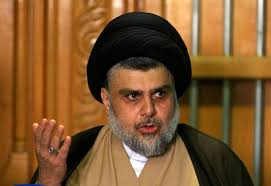
BAGHDAD: Iraq’s Muqtada al-Sadr, the maverick Shiite cleric whose political coalition beat out Iran’s favored candidates to come in first in national elections, says he wants to form a government that puts Iraqis first.
The electoral commission announced early Saturday that the militant-turned-populist preacher, who has long spoken out against both Iranian and US influence in Iraq, had defeated his establishment rivals.
Al-Sadr — who is remembered for leading an insurgency against US forces after the 2003 invasion — did not run for a seat himself and is unlikely to become prime minister, but will command a significant number of seats and has already begun informal talks about government formation.
Salah al-Obeidi, a spokesman for al-Sadr’s Sa’eroun political bloc, told The Associated Press that Iraq’s sovereignty was going to be the new government’s “guiding principle.” “We warn any other country that wants to involve itself in Iraqi politics not to cross the Iraqi people,” he said.
However, even as al-Sadr is in position to nominate a prime minister and set the political agenda for the next four years, he will find his choices limited by Iran. The Middle East’s pre-eminent Shiite power has a direct line with some of Iraq’s most powerful politicians, and it is trying to rally them as a bloc to undercut al-Sadr.
Al-Sadr’s rise threatens Iran’s claim to speak on behalf of Iraq’s Shia majority, a precedent that could fuel independent Shiite movements elsewhere. Also at stake are top ministerial posts — political appointments that are a source of patronage and police and military power.
Al-Sadr himself has kept a relatively low public profile. But in a public relations move that appeared to be directed at Iran, he appeared on Thursday with rival cleric Ammar al-Hakim, who has drifted away from Iran’s orbit in recent years, to say the two men share similar visions for the next government.
Tehran has dispatched its top regional military commander, Gen. Qassem Soleimani, to pull together a coalition to counterbalance al-Sadr, according to an Iraqi Shiite militia commander who is familiar with the meetings.
“Iran won’t accept the creation of a Shiite bloc that is a threat to its interests. It’s a red line,” said the commander, who spoke on the condition of anonymity because of the sensitivity of the discussions.
Al-Sadr’s relationship with Iran is a complicated one. Though he has maintained close ties with Iran’s political and religious leadership, in recent years he has denounced the flow of Iranian munitions to Shiite militias in Iraq, all the while maintaining his own so-called Peace Brigades in the holy city of Samarra, north of Baghdad.
Al-Sadr’s former Mehdi Army militia, which spearheaded an insurgency against the US, clashed violently with the Iran-backed Badr Organization last decade.
The militias plugged the gaps left by Iraq’s army as soldiers deserted their posts in the face of the Islamic State group’s lightning campaign in the summer of 2014. With direction from Iran’s Revolutionary Guard, they turned the tide against the initial advance. In the years that followed, the militias — coordinating with US-backed Iraqi ground forces — slowly pushed IS fighters back. Iraq declared victory over the group last year.
Al-Sadr has said he wants the militias absorbed into the national security forces, a move Iran would find difficult to accept.
Iran is also rankled by al-Sadr’s recent overtures to Saudi Arabia and the United Arab Emirates, which are locked in proxy wars with Tehran in Syria and Yemen. Al-Sadr met with the crown princes of Saudi Arabia and Abu Dhabi in August, leading Iran’s hard-line Keyhan newspaper to accuse al-Sadr of “selling himself” to the house of Saud.
Canada contributes $15m for Iraqi Women
The Canadian Department of Foreign Affairs, Trade and Development (DFATD) has contributed CAD 20 million ($15 million) in support of...