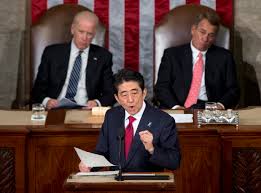
NEW YORK: In a historic speech to Congress, Japanese Prime Minister Shinzo Abe celebrated the evolution of ties with the U.S. since his nation’s defeat in World War II and urged lawmakers to seal a groundbreaking Asia-Pacific trade deal.
Abe’s address to a joint meeting of Congress was the first by a Japanese head of state. He offered “eternal condolences” for American lives lost in World War II and underscored what he called his country’s aim to make a “proactive contribution to peace.” Before the address, he laid a wreath at the National World War II Memorial on Washington’s National Mall.


Japan is “resolved to take yet more responsibility for the peace and stability in the world,” Abe said. “Let the two of us, America and Japan join our hands and do our best to make the world a better, a much better place to live”
Abe’s congressional address was the highlight of his week-long visit to the U.S., aimed at showcasing the world’s third-largest economy as a close ally willing and able to help advance American economic and strategic goals in Asia and beyond. He depicted the 12-nation trade pact, known as the Trans-Pacific Partnership, as a keystone of the relationship.
Defying protestors outside the Capitol, Abe offered no new apology to women from Korea and other nations forced into prostitution by the Japanese Imperial Army in the early 20th century. He instead expressed “deep remorse” for unspecified suffering caused by his nation’s wartime actions, for which the Japanese “must not avert our eyes.”
Comfort Women
Abe, 60, said that Japan’s war-era military “brought suffering to the peoples in Asian countries,” and that he “will uphold the views expressed by the previous prime ministers in this regard.”
One former so-called “comfort woman,” Lee Yong Soo, attended Abe’s speech as a guest of Representative Mike Honda, a California Democrat.
“There’s not many of us left and he can wait for us to die out but that won’t erase Japan’s crimes,” Lee, now 86, told reporters before the speech, sitting in a wheelchair in front of the Capitol. She said she was forced into sexual slavery at age 16.
Hundreds of Korean-American protesters from Maryland, Virginia and New York flanked Lee, chanting “apologize, apologize, apologize.”
Rice, Cars
Abe began his 43-minute address by sharing his experiences living in the U.S. as a student at the University of Southern California. He recalled his appreciation of his host family’s Italian cooking and joked about American mispronunciations of his name, winning applause and laughter from the audience.
The speech was Abe’s opportunity to pitch reluctant lawmakers on the Asia-Pacific trade deal.
He said Japan had undertaken “sweeping reforms” of its agriculture sector, to address U.S. concern about the industry’s decades-long reluctance to open its markets. He invited Congress to visit the “New Japan” and witness changes made to “old habits.”
“Japan’s agriculture is at a crossroads,” he said. “In order for it to survive, it has to change now.”
U.S. and Japanese negotiators working on an initial bilateral trade deal between the two countries, intended as a foundation for the broader accord, are stuck on issues around agriculture and automobiles. U.S. farmers want lower Japanese duties on pork, dairy products and rice, while Japan wants a 2.5 percent tariff on cars exported to America to be eliminated.
Changed Minds
Lawmakers “are pretty well positioned” on the trade deal, Senator Ben Cardin of Maryland, the top Democrat on the Foreign Relations Committee, said after the speech. “But a few changed minds can make a difference.”
Representatives Raul Grijalva, an Arizona Democrat, and Keith Ellison, a Minnesota Democrat, who co-chair a caucus of liberal lawmakers, are likely not among them. The trade deal must include “enforceable protections against currency manipulators,” including Japan, they said in a statement.
“If the administration wants the U.S. to lead good trade deals, we must include rules to stop Japan and other countries from inflating the value of the dollar,” they said.
The pact would result in an economic market that is “fair, dynamic, sustainable, and is also free from the arbitrary intentions of any nation,” Abe said.
’Lasting Peace’
“We must turn the area into a region of lasting peace and prosperity,” he said. “That is for the sake of our children and our children’s children.”
On Tuesday, Abe and President Barack Obama said at a White House news conference that the trade deal represents no threat to China, the world’s second-largest economy, which is excluded from the agreement.
Abe received the longest standing ovations from U.S. lawmakers after he expressed condolences for American deaths in World War II and said that the former enemy nations are now “bonded in spirit.”
He wrapped up his remarks with lyrics from a Carole King song he listened to on the radio in high school.
“Yes, we’ve got a friend in you,” he told the lawmakers.
More than two dozen women lawmakers, including Representative Kay Granger, a Texas Republican, and Nancy Pelosi, a California Democrat, wore red to the speech. The women wear red on Wednesday to express solidarity with kidnapped Nigerian girls, Pelosi spokesman Drew Hammill said in an e-mail.