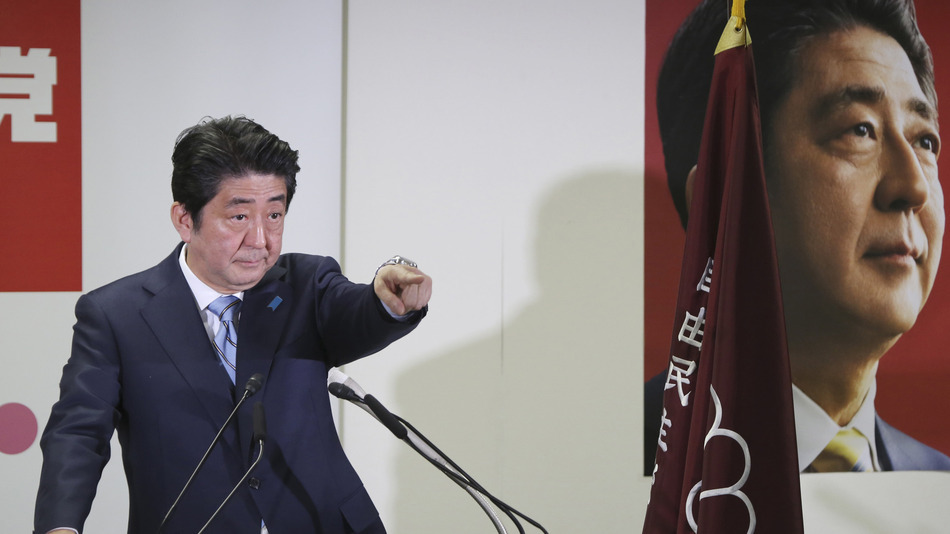
Japan’s Prime Minister Shinzo Abe vowed Monday to prevail over resistance to his plans for economic and political change following a weekend election victory that gives him up to four more years in power.
In Sunday’s snap election, the conservative Liberal Democratic Party that has ruled for most of the post-World War II era locked up a solid majority of at least 291 seats. About 35 seats were claimed by the LDP’s coalition partner, the Buddhist-backed Komei party, giving the ruling bloc more than two-thirds of the 475-seat House of Representatives.

That majority could enable the coalition to override resistance in the upper house, but not necessarily the powerful vested interests and bureaucrats opposed to major reforms many economists say are needed to revitalize Japan’s economy.
“We are taking the energy, power and support we received from the voters and will firmly and directly proceed ahead,” a visibly weary but relaxed Abe said in a news conference. “We still face a mountain of difficult problems that needs to be tackled.”
Businesses are reluctant to sink their cash hoards in a shrinking home market, farmers are dead set on keeping their cushion of subsidies and tariffs, and voters remain wary of many of Abe’s plans. The election victory changes none of that.
Japan could gain significantly by boosting its productivity through labor reforms and improving business conditions for foreign companies, but such initiatives have made little headway.
“Don’t look for bold new economic reforms,” said Gerald Curtis, a politics professor at Columbia University who was in Tokyo. “I think we’ll see pretty much more of the same. Labor market reform? I don’t see it happening.”
The ruling coalition’s solid majority — and the four-year span until the next lower house election must be held — does give the rightward-leaning Abe space to move ahead on some of his longer-term political goals. They include revising Japan’s pacifist constitution to expand the role of its military and allow restrictions of freedoms such as speech and expression if they are deemed to harm the public interest.
But many Japanese are wary of Abe’s nationalistic goals, and a heated debate is expected when parliament is expected to take up the proposals to expand Japan’s military role, likely after local elections in April. The public also has qualms about the LDP’s desire to restart nuclear plants idled after the March 2011 Fukushima disaster.
If turnout is any indication, Japanese voters aren’t exactly excited about any of their political leaders. Kyodo news agency estimated voter turnout at 52.7 percent, a post-World War II record low and down nearly 7 percentage points from the previous lower house election in 2012.
Abe successfully wagered that voters would stick with him despite the recession and those qualms. He says his top priority remains the economy, which fell back into recession after a tax hike in April. He pledged to draw up a set of stimulus policies before the year’s end.
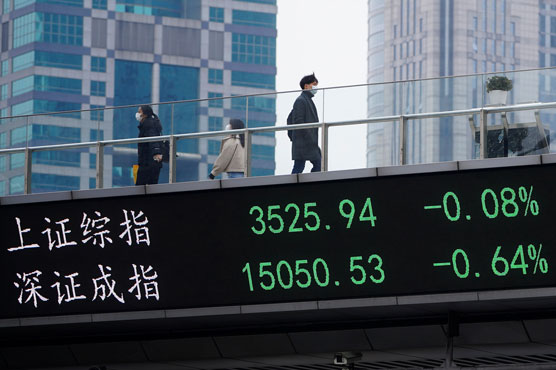
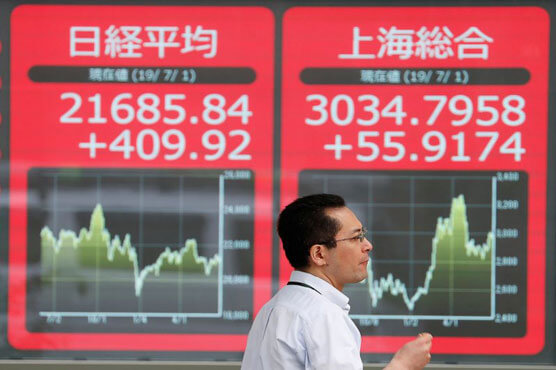
The “Abenomics” blend of aggressive monetary easing, public spending and economic reforms has pushed share prices higher and weakened the value of the yen, helping big exporters like Toyota Motor Corp. But wages and business investment have remained sluggish, and inflation and growth have fallen short of the targets set by Abe when he took office two years ago.
Abe has lobbied for a stronger role for women in both government and business, in part to make up for the decline in its work force as the baby boom generation retires. But in a country where gender equality remains more theory than reality, he can get only so far.