Customs Today
  • Home
  • Islamabad
  • Karachi
  • Lahore
  • National
  • Transfers and Postings
  • Chambers & Associations
  • Business
No Result
View All Result
Customs Today
  • Home
  • Islamabad
  • Karachi
  • Lahore
  • National
  • Transfers and Postings
  • Chambers & Associations
  • Business
No Result
View All Result
Customs Today
No Result
View All Result
Home Science & Technology Science

Jet Propulsion Laboratory seeking $30 million from NASA to build Mars drone

byCustoms Today Report
02/02/2015
in Science, Science & Technology
Share on FacebookShare on Twitter

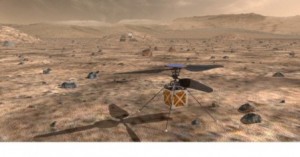
NEW YORK: The Jet Propulsion Laboratory is seeking $30 million from NASA to build a Mars drone expected to survive at least one month in a harsh environment.

For the past year and a half, JPL scientists have been studying the Mars Helicopter, a low-flying scout that could triple the distance Mars rovers travel in a single Red Planet day, study scientist Matthew Golombek said.


You might also like

Tesla driverless system to use updated radar technology

12/09/2016

Apple to develop its own self-driving technology

10/09/2016

“It’s too cheap not to put it on (a rover), or so we hope,” Golombek said, adding that the Mars 2020 rover is budgeted at $1.5  billion and the Curiosity rover mission is working with $2.5  billion in funding.

The 2.2-pound prototype looks like a medium-size, cube tissue box. With a 3.6-foot blade span, the Mars Helicopter would provide a much-appreciated aerial view to complement the limited field of vision currently available from cameras aboard rovers.

Although orbiters provide supplemental data for scientists and engineers who plan a rover’s path, the highest resolution is about 25  centimeters per pixel. Scientists could identify objects that are about 3  feet across. But to distinguish key outcrops and to help plan a pathway, NASA needs something that could provide photos with 10 times that resolution, Golombek said.

Enter the drone, which would be able to take photos at a resolution of 3  centimeters per pixel.

“High enough to see all key rocks and paths,” Golombek said. “Because the helicopter is so flexible, the resolution is just how high we fly. We can even land and take close-up images of rocks.”

The proposed add-on is expected to fly and take pictures for about three minutes a day. It could travel about 1,970 feet in one flight and would typically hover about 130 feet above the surface of Mars, Golombek said.


Related Stories

Tesla driverless system to use updated radar technology

byCT Report
12/09/2016

WASHINGTON: Electric carmaker Tesla announced Sunday it was upgrading its Autopilot software to use more advanced radar technology. In a...

Apple to develop its own self-driving technology

byCT Report
10/09/2016

SAN FRANCISCO: Apple may not become an automaker, but it still wants to develop its own self-driving technology. The iPhone-maker's...

NASA spots slowest known magnetar

byCT Report
10/09/2016

WASHINGTON: Astronomers have found evidence of a magnetar - magnetised neutron star - that spins much slower than the slowest...

‘YouTubers’ outshining old-school television

byCT Report
09/08/2016

SAN FRANCISCO: A media revolution is taking place, and most people over 35 years of age aren’t tuned in. Millennial...

Next Post

Hyderabad customs assures traders of easier, faster clearance

  • Terms and Conditions
  • Disclaimer

© 2011 Customs Today -World's first newspaper on customs. Customs Today.

No Result
View All Result
  • Transfers and Postings
  • Latest News
  • Karachi
  • Islamabad
  • Lahore
  • National
  • Chambers & Associations
  • Business
  • About Us

© 2011 Customs Today -World's first newspaper on customs. Customs Today.