Customs Today
  • Home
  • Islamabad
  • Karachi
  • Lahore
  • National
  • Transfers and Postings
  • Chambers & Associations
  • Business
No Result
View All Result
Customs Today
  • Home
  • Islamabad
  • Karachi
  • Lahore
  • National
  • Transfers and Postings
  • Chambers & Associations
  • Business
No Result
View All Result
Customs Today
No Result
View All Result
Home Science & Technology Science

Jupiter may be behind mysterious ‘gaping hole’ in our 4.6 billion yrs old solar system

byCustoms Today Report
25/03/2015
in Science
Share on FacebookShare on Twitter

You might also like

Astronomers discover distant dwarf planet beyond Neptune

12/07/2016

Nasa’s Juno successfully begins orbit of Jupiter

05/07/2016

LONDON: While our Solar System is estimated to be 4.6 billion years old, just what was happening during all that time remains something of a mystery, with new finds and data constantly tweaking the accepted theories.
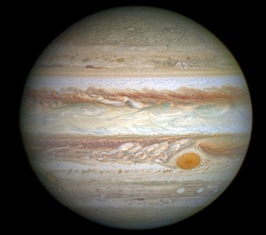
With the release of a new article by the Proceedings of the National Academy of Sciences journal, new information about the early habits of our largest planet Jupiter may remold how we look at the evolution of the Solar System.
The two researchers, Gregory Laughlin of the University of California, Santa Cruz and Konstantin Batygin of the California Institute of Technology have reimagined how our early Solar System may have been arranged and how Jupiter played a part in its current set-up.
Imagine that the earlier inner Solar System was crowded with debris and a number of planets called “super-Earths”. These have a larger mass than our Earth but are not necessarily habitable. The two astronomers ran the numbers and believe that Jupiter may have deviated from its outer orbit and moved in closer to the Sun.
This in turn disrupted the orbits of those super-Earths, causing them to careen into the Sun. With the formation of Saturn, Jupiter was the pull away from the Sun to its current orbit.
The upshot of all this moving around? Without Jupiter to clear the previous planets, there would have been no room for Earth as we know it.
Laughlin uses this data to compare or Solar System with others, to understand why we have so many rocky planets, such as Earth and Mars, comparatively close to the Sun.
Related Stories

Astronomers discover distant dwarf planet beyond Neptune

byCT Report
12/07/2016

LONDON: A dwarf planet half the size of Britain has been found tumbling through space in the most distant reaches...


Nasa’s Juno successfully begins orbit of Jupiter

byCT Report
05/07/2016

MIAMI: Nasa's unmanned Juno spacecraft has begun orbiting Jupiter, a key triumph for a $1.1 billion mission that aims to...

Coal dust kills 23,000 per year in European countries

byCT Report
05/07/2016

PARIS: Lung-penetrating dust from coal-fired power plants in the European Union claims some 23,000 lives a year and racks up...

Helium shortage could be solved by new life-saving discovery

byCT Report
28/06/2016

LONDON: Scientists might finally have overcome a global shortage of helium – potentially saving millions of lives in the process....

Next Post

NASA's MAVEN spacecraft finds for 1st time mysterious Martian dust cloud, aurora lights 93-190 miles above surface

  • Terms and Conditions
  • Disclaimer

© 2011 Customs Today -World's first newspaper on customs. Customs Today.

No Result
View All Result
  • Transfers and Postings
  • Latest News
  • Karachi
  • Islamabad
  • Lahore
  • National
  • Chambers & Associations
  • Business
  • About Us

© 2011 Customs Today -World's first newspaper on customs. Customs Today.