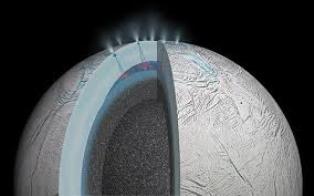


WASHINGTON: Jupiter-orbiting moon Ganymede harbors an ocean beneath its icy surface, confirms NASA. The researchers reached the conclusion with the help of the Hubble Space Telescope and the finding significantly raises the probability of finding life on Ganymede. NASA’s now-defunct Galileo spacecraft, while exploring Jupiter and its moons from 1995 to 2003, had indicated that Ganymede probably has a subsurface ocean and the recent finding has resolved this mystery which prevailed since long.
Ganymede hosts a liquid-iron core, just like Earth, which generates a magnetic field. However, Ganymede’s field is embedded within Jupiter’s magnetic field and as a result twin bands of glowing aurora around Ganymede’s northern and southern polar regions can be witnessed. With rotation, the magnetic field of Jupiter shifts which affects the position of Ganymede’s aurora. Computer models demonstrated that if there was no ocean on Ganymede, the aurorae would rock back and forth across about six degrees of the moon’s circumference while orbiting Jupiter. However, the salty, electrically conductive ocean present beneath the icy crust stabilizes the aurorae, allowing them to move only about two degrees.
Joachim Saur, a geophysicist at the University of Cologne in Germany stated “Jupiter is like a lighthouse whose magnetic field changes with the rotation of the lighthouse. It influences the aurora. With the ocean, the rocking is considerably reduced.” More computer models were used by the researchers to determine whether anything else is impacting Ganymede’s aurora. Even the repeated analysis of both belts of aurora revealed the same results. Ganymede is now enlisted among the moons with subsurface water. Recently scientists have revealed that Saturn’s moon Enceladus has hot springs beneath its icy crust. Jupiter moons Europa and Callisto also harbor water.

Karachi Port sets 138-year cargo handling record
KARACHI: Pakistan's maritime sector has achieved a major milestone as Karachi Port set a new record in its 138-year history...