

Customs Today
  • Home
  • Islamabad
  • Karachi
  • Lahore
  • National
  • Transfers and Postings
  • Chambers & Associations
  • Business
No Result
View All Result
Customs Today
  • Home
  • Islamabad
  • Karachi
  • Lahore
  • National
  • Transfers and Postings
  • Chambers & Associations
  • Business
No Result
View All Result
Customs Today
No Result
View All Result
Home Science & Technology Science

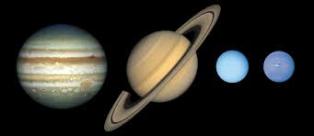
Jupiter, Saturn, Uranus and Neptune are gas giants of our solar system

byCustoms Today Report
27/08/2015
in Science, Science & Technology
Share on FacebookShare on Twitter

You might also like

Tesla driverless system to use updated radar technology

12/09/2016

Apple to develop its own self-driving technology

10/09/2016

WASHINGTON: Jupiter, Saturn, Uranus and Neptune are gas giants of our solar system. These four planets are also known as Jovian planets. The gas giants greatly comprise gases such as helium and hydrogen along with a small rocky core.
These planets are located in the outer part of solar system of Earth past the Mars’ orbit and the asteroid belt. Jupiter and Saturn are considerably bigger than Neptune and Uranus. It indicates that the pairs of planets have a different composition.
Astronomers have found thousands of large planets out of our solar system by making use of NASA’s Kepler space telescope. These exoplanets are being studied to know more regarding how our solar system originated.
Jupiter is the biggest planet in our solar system. It is having a radius nearly 11 times Earth’s size. According to NASA, it is having 50 known moons and 17 are yet to be confirmed. The planet is largely made of helium and hydrogen around a dense core of ice and rocks, with most of it probably composed of liquid metallic hydrogen that leads to creation of a massive magnetic field.
Jupiter could be seen with the naked eye and the ancients also knew about it. Its atmosphere comprises mostly of helium, hydrogen, methane and ammonia.
Saturn is approximately nine times radius of Earth and is distinguished by huge rings; formation circumstances of them are a mystery. According to NASA, it is having 53 known moons and nine more that are yet to be confirmed.

Related Stories

Tesla driverless system to use updated radar technology

byCT Report
12/09/2016

WASHINGTON: Electric carmaker Tesla announced Sunday it was upgrading its Autopilot software to use more advanced radar technology. In a...

Apple to develop its own self-driving technology

byCT Report
10/09/2016

SAN FRANCISCO: Apple may not become an automaker, but it still wants to develop its own self-driving technology. The iPhone-maker's...

NASA spots slowest known magnetar

byCT Report
10/09/2016

WASHINGTON: Astronomers have found evidence of a magnetar - magnetised neutron star - that spins much slower than the slowest...

‘YouTubers’ outshining old-school television

byCT Report
09/08/2016

SAN FRANCISCO: A media revolution is taking place, and most people over 35 years of age aren’t tuned in. Millennial...

Next Post

American consumers sue world’s biggest carmakers for 'deadly' keyless ignitions, leading to 13 deaths

  • Terms and Conditions
  • Disclaimer

© 2011 Customs Today -World's first newspaper on customs. Customs Today.

No Result
View All Result
  • Transfers and Postings
  • Latest News
  • Karachi
  • Islamabad
  • Lahore
  • National
  • Chambers & Associations
  • Business
  • About Us

© 2011 Customs Today -World's first newspaper on customs. Customs Today.