
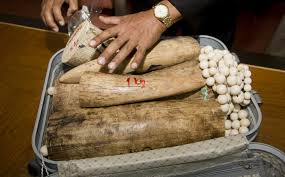
NAIROBI: customs authorities seized fifty pieces of ivory in shipment bound for Singapore from Kenya.
According to a Uganda Wildlife Authority spokesperson, the ivory had been hidden in a shipment of shea butter which is normally used in the manufacture of cosmetics. The shipment had been declared as 1,000 kilos of the butter, but a closer inspection by alert customs officers found the fifty pieces of ivory secreted within different barrels of the butter.
The shipment had been scheduled to leave on a cargo plane belonging to Ethiad Airways from Kampala airport.
Speaking to the AFP news agency, the Uganda Wildlife Authority spokesperson, Jossy Muhangi said: “The people who delivered the consignment ran away and we are hunting for them.”
Earlier this year, Ugandan authorities also seized a consignment of 700 kilos of ivory that was suspected to have originated in the Democratic Republic Of Congo.
Ivory can fetch up to US$2100 per kilo on the black market in East Asia, making that particular shipment worth approximately US$1.5 million.
The Democratic Republic Of Congo has also been the source of other shipments of ivory that were seized in Mombasa, the main port in Kenya, last year.
In a report issued in June 2014, the Secretariat of the Convention on International Trade in Endangered Species of Wild Fauna and Flora (CITES) said that over 20,000 elephants were poached in 2013.
The report also said that the increasing trend in poaching since the mid 2000s appeared to be peaking, but poaching still remained at “alarmingly high” levels.
The report was compiled using figures from the CITES Monitoring Illegal Killing in Elephants (MIKE) programme and the Elephant Trade Information System (ETIS).
According to CITES, one notable change was that there was an increase in the number of large ivory shipments that had been seized in Africa, and for the first time, these exceeded those made in Asia. Three Countries accounted for 80% of the seizures made in Africa: Kenya, Tanzania, and Uganda.
The success in terms of ivory seizures can be chartered back to March 2013, when CITES identified eight countries (Kenya, Tanzania, Uganda, China, Malaysia, The Philippines, Thailand, and Viet Nam) as being source, transit or destination countries, and requested the countries to develop and implement National Ivory Action Plans.
In a statement, John E. Scanlon, Secretary-General of CITES said: “Africa’s elephants continue to face an immediate threat to their survival from high-levels of poaching for their ivory and with over 20,000 elephants illegally killed last year the situation remains dire. Due to the collective efforts of so many, we also see some encouraging signals, but experience shows that poaching trends can shift dramatically and quickly, especially when transnational organized crime is involved.”
NAIROBI: customs authorities seized fifty pieces of ivory in shipment bound for Singapore from Kenya.
According to a Uganda Wildlife Authority spokesperson, the ivory had been hidden in a shipment of shea butter which is normally used in the manufacture of cosmetics. The shipment had been declared as 1,000 kilos of the butter, but a closer inspection by alert customs officers found the fifty pieces of ivory secreted within different barrels of the butter.
The shipment had been scheduled to leave on a cargo plane belonging to Ethiad Airways from Kampala airport.
Speaking to the AFP news agency, the Uganda Wildlife Authority spokesperson, Jossy Muhangi said: “The people who delivered the consignment ran away and we are hunting for them.”
Earlier this year, Ugandan authorities also seized a consignment of 700 kilos of ivory that was suspected to have originated in the Democratic Republic Of Congo.
Ivory can fetch up to US$2100 per kilo on the black market in East Asia, making that particular shipment worth approximately US$1.5 million.
The Democratic Republic Of Congo has also been the source of other shipments of ivory that were seized in Mombasa, the main port in Kenya, last year.
In a report issued in June 2014, the Secretariat of the Convention on International Trade in Endangered Species of Wild Fauna and Flora (CITES) said that over 20,000 elephants were poached in 2013.
The report also said that the increasing trend in poaching since the mid 2000s appeared to be peaking, but poaching still remained at “alarmingly high” levels.
The report was compiled using figures from the CITES Monitoring Illegal Killing in Elephants (MIKE) programme and the Elephant Trade Information System (ETIS).
According to CITES, one notable change was that there was an increase in the number of large ivory shipments that had been seized in Africa, and for the first time, these exceeded those made in Asia. Three Countries accounted for 80% of the seizures made in Africa: Kenya, Tanzania, and Uganda.
The success in terms of ivory seizures can be chartered back to March 2013, when CITES identified eight countries (Kenya, Tanzania, Uganda, China, Malaysia, The Philippines, Thailand, and Viet Nam) as being source, transit or destination countries, and requested the countries to develop and implement National Ivory Action Plans.
In a statement, John E. Scanlon, Secretary-General of CITES said: “Africa’s elephants continue to face an immediate threat to their survival from high-levels of poaching for their ivory and with over 20,000 elephants illegally killed last year the situation remains dire. Due to the collective efforts of so many, we also see some encouraging signals, but experience shows that poaching trends can shift dramatically and quickly, especially when transnational organized crime is involved.”





