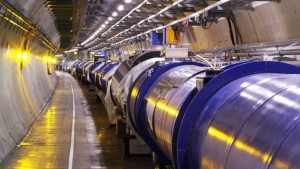
LONDON: CERN’s Large Hadron Collider has been accomplishing some impressive things throughout its time. While it took a several year hiatus from activity, the Large Hadron Collider, or LHC, managed to capture something impressive that researchers had previously missed several years ago. The discovery would have occurred during the 2011 and 2012 data collection periods and during that time researchers believe that they had seen a B meson decay into a pair of muon particles.
These meson particles are essentially subatomic matter, or particles that break down quickly due to their volatile nature. Guy Wilkinson of the LHC team pointed out that, “It is testament to the excellent performance of the LHC, and the sensitivity of our experiments, that we have been finally able to observe this extremely rare but important decay.” The finding is remarkable, but the finding is something that scientists would never have expected to find with this particular data sweep.


Tiziano Camporesi, a spokesperson for the team that actually put together the data through the extensive analytical stage that this data went through pointed out, “The search for new particles and the study of rare decays are complementary strategies for discovering new physics.” However, the CERN team pointed out in a statement that said, “These rare decays have not revealed any hints of new physics.”