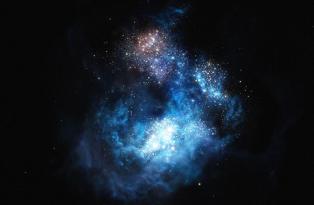


CANADA: The Very Large Telescope has spotted signs that may indicate the presence of the oldest stars in the universe — formed from matter created by the Big Bang.
In the beginning there was nothing. Then there was something: the Big Bang, forging gas — hydrogen, helium, lithium. At some point in the chaos that followed, stars formed from this primordial soup. Pristine gases spun into stellar bodies. A generation of stars (whose existence is theoretical) created light in the darkness.
These Population III stars, as they are known, are theoretically the turning point for the universe: taking the gases and turning them into the heavier elements: carbon, oxygen, iron, nitrogen and metallic elements.
But though there had to have been a first generation of stars, we’ve never actually seen them. This is because, massive, hundreds of times larger than the sun, they burned huge, hot, bright — and fast. Scientists believe that these stars from the dawn of time burned out after just two million years.
We haven’t seen them — but we may now have seen the very first evidence of their existence.
A team of researchers led by David Sobral from the Institute of Astrophysics and Space Sciences in Portugal has found what it believes to be good evidence for clusters of Population III stars in a galaxy located some 13.02 billion years away — 800 million years after the Big Bang.

Karachi Port sets 138-year cargo handling record
KARACHI: Pakistan's maritime sector has achieved a major milestone as Karachi Port set a new record in its 138-year history...