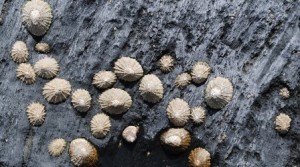


NEW YORK: The strongest material in the world can be found inside the mouths of rock-dwelling marine gastropods.
If you’ve ever been to the ocean, you’ve seen limpets: conical shells that seem glued to rocks and piers, almost impossible to pry loose. This is because they have a strong, muscular foot that can adhere to irregularities in the rock’s surface. Combined with an adhesive mucus, this keeps the limpet from being washed away, and keeps moisture sealed inside its shell during low tide.
While clinging to the rock, the limpet uses a sort of “tongue” called a radula to feed. This is a long, chitinous ribbon, embedded with rows tiny sharp “teeth” that allow the limpet to scrape algae from the rock. And, according to new research, these teeth are the strongest natural material on Earth.
“Nature is a wonderful source of inspiration for structures that have excellent mechanical properties. All the things we observe around us, such as trees, the shells of sea creatures and the limpet teeth studied in this work, have evolved to be effective at what they do,” said study leader Professor Asa Barber of the University of Portsmouth’s School of Engineering.
“Until now we thought that spider silk was the strongest biological material because of its super-strength and potential applications in everything from bullet-proof vests to computer electronics; but now we have discovered that limpet teeth exhibit a strength that is potentially higher.”
The team used atomic force microscopy to examine the teeth, a method used to dissect materials all the way down to the atomic level. The sample used was microscopic — 100 times thinner than a human hair. The technique for breaking down a sample of this size has only just been discovered.
Inside the teeth, the team discovered a mineral called goethite, which falls at about 5.0 to 5.5 on the Mohs Scale of hardness. This mineral develops inside the limpet as it grows. The tooth is also curved, which contributes to its strength.

Karachi Port sets 138-year cargo handling record
KARACHI: Pakistan's maritime sector has achieved a major milestone as Karachi Port set a new record in its 138-year history...