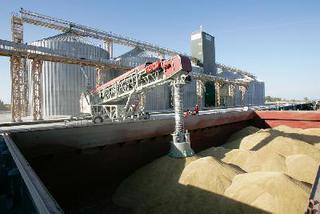
BUENOS AIRES: The drop in soy bean prices has tightened up Central Bank’s foreign currency reserves.
Sales abroad during soy harvest season down 31 percent, equalling drop in global value


The drop in Argentine grain exports seems to be largely a reflection of the drop in international grain prices.
Although other factors such as hoarding could still be playing a role, the latest figures show the progression of grain sales has been similar to the global price drop as of late.
According to figures released by the CIARA-CEC grain exporting chambers, a 31.4 fall has been seen so far this year. Since the beginning of the soy harvesting season in the second quarter, exports saw a similar 31 percent drop.
In the last twelve months, meanwhile, the price of Argentina’s main agricultural export, soy bean, has dropped 34 percent, while corn and wheat fell 28 and 29 percent respectively.
Last Friday, on the last day included on CIARA-CEC’s calculations, a ton of soy bean was traded at US$356.33, while a year before the same amout could be sold for US$540.88.
When the comparison is made between new year 2015 and new year 2014, the fall in prices hasn’t been as steep, but still explains a large part of the plunge in sales, which are measured in US dollars and not production volume.
Soy bean prices were down 21 percent on January first —at US$374 per ton, when compared to the first working day of 2014, when soy was tradeing at US$473 per ton—.
That means that although the drop in soy harvest season exports can be mostly explained by global prices, the same is not completely true when the whole of 2015 is considered. Still, around two thirds of the drop in 2015’s sales seems to be explained by market prices.
The ‘tailwind’ debate
The drop in global prices of Argentina’s main exports came at a bad time for the national government, which struggled during the last year to contain the demand from importers while trying to preserve the amount of foreign currency reserves without resorting to another devaluation of the peso.
In January 2014, when a large part of the drop in grain prices had still not taken place, Central Bank authorities decided to stop sustaining the peso through the sale of its US dollar reserves, as they were falling at an increasingly speedy rate.
But the government vowed not to repeat that scenario when the pressure to buy its dollar reserves jumped up again, opting instead to bolster them through bond issues and loans from China in 2015.
This earned the Central Bank some breathing room to come through the election year unscathed so far, but the reduced income from the soy harvesting season means that the country will be more dependent on loans to get to the end of the year.
After the elections, analysts and markets forecast that the rate at which the peso devalues will jump up again, as the candidate that wins the presidential seat is expected to prioritize international competitiveness over dollar-measured local wages.
According to opposition critics, a large part of the country’s prosperity in the last decade was explained by almost unprecedentedly high prices for the country’s exports, which they describe as “tailwind”.
But the government counters that reduced unemployment and increased equality would not have been possible without the active role that the state was given by the Kirchnerite administration, allowing redistribution to take place and subsidizing local industries.