If land and sea borders are the nation’s doors, Malaysia’s doors seem wide open. Terrorism, piracy, smuggling, narcotics trade, human trafficking, and illegal immigrants are all major problems that need to be tackled at the country’s boundaries.
The country, for instance, has taken in tens, perhaps hundreds of thousands of Indonesian Muslims who have crossed the border into East Malaysia from Kelantan to seek work in a wealthier country. Substantial numbers of them have been issued identity cards to become voters aligned with Malay political parties.

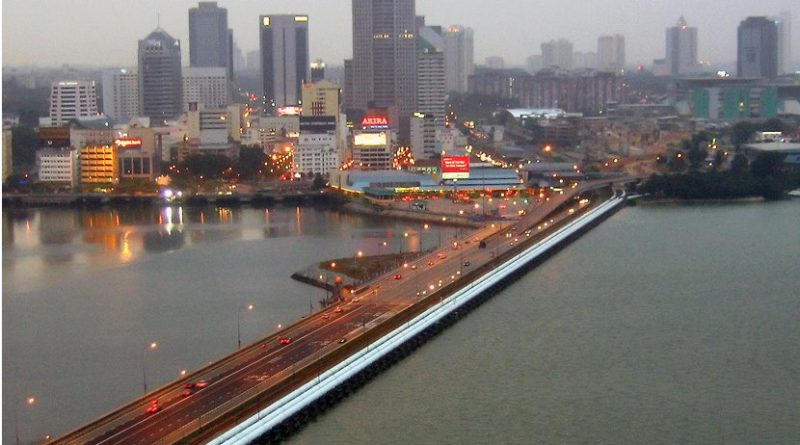
Malaysia’s problems are exacerbated by the fact that the country is bifurcated into the Malay Peninsula and the North Borneo states of Sabah and Sarawak. The two are separated by 600-1,200 kms of open sea. It shares 3,147 km of land borders with Thailand on the peninsula and Brunei, along with Indonesia, on the island of Borneo. Malaysia also shares maritime borders with Singapore, connected by a bridge and causeway, and sea boundaries with the Philippines, China and Vietnam.
Given that much of Malaysia’s land borders are situated along hilly jungle and the maritime borders are sparse, management and protection are extremely challenging. After nearly 57 years of nationhood, many regions are still not clearly delineated. Two areas along Malaysia’s land border with Thailand are still in dispute, along with final boundary delineation along the continental shelf in the South China Sea.
Malaysia and Brunei still dispute boundaries in the district of Limbang, and a number of areas along the Sarawak-Brunei borders must be jointly delineated. There are also competing claims over the Spratly Islands with the Philippines, China, Taiwan, and Vietnam. There are regular maritime standoffs within this area.
Malaysia and Singapore are currently in dispute over Singapore’s Tuas Port boundaries, with Malaysia claiming the port boundaries encroach Malaysia’s border. Tensions have heightened of late and a standoff occurred earlier this year. Malaysia lost in a claim of sovereignty over a lighthouse on top of rocks named Pedro Branca/Pulau Batu Puteh with Singapore in the International Court. There is a continuing dispute over Singaporean control of Malaysian airspace over Johor, and potentially the possibility of another dispute arising over Pulau Pisang, where the Singapore Port Authority has increased the size of the lighthouse complex there.
Clearly defined delineation isn’t the only issue weighing over Malaysia’s border regions. The Thai province of Satun and Malaysian state of Perlis are quiet rural regions that have many shared family, cultural, and small-scale trade links. It takes more than two hours between cities only 10 km apart, by small boat from Kuala Perlis. A more direct link would boost needed development of one of Malaysia’s poorest states.
The most volatile issue, however, is the discovery of transit camps with mass graves of Rohingya and Bangladeshis at Wang Kelian by a journalist in 2015, proof that human trafficking was organized and rampant across unclear borders. Most of the Wang Kelian border area is state forest and requires a permit from the state Forestry Department to enter, preventing outsiders from discovering the horrors that had been going on in the camps for years.
Even though the transit camps were destroyed by Malaysian police soon after discovery, human trafficking continues. Syndicates are using either holes through the border fences around Padang Besar or walking through trails across the Bintang Mountains into the Bukit Ayer area in Perlis, where they are taken deep into Malaysian territory by car.
Recent arrests also indicate that Padang Besar on the Malaysian side is a human trafficking staging area, where foreigners are sent under forged documents to Europe. Although high ranking military and civil personnel, including the mayor of Padang Besar have been arrested and convicted on the Thai side, there have been no Malaysian arrests or convictions in relation to the camps. The slow reaction by Malaysia police after the discovery of the mass graves, suggests to critics that elements in the police, possibly the Special Branch, are covering up corruption.
Around that time federal authorities, against protests from Perlis state, closed the Wang Kelian-Wang Prachan cross border market which draws thousands of local tourists each week to take shop on the Thai side without the need to show documentation. Wang Kelian has gone from once-bustling to a ghost town with a great cost on local Perlis tourism.
Squatters are also encroaching the Wang Kelian State Forest, cutting virgin forest for small-scale farming. Border patrol and forestry department personnel have tended to leave them alone rather than enforce the park’s integrity due to political patronage.
Padang and Sadao CIQ Complexes often experience traffic jams due to the rapidly increasing volume at these border crossings. Immigration computers often fail, requiring officers to manually process transit documents. Extended observation by Asia Sentinel found that only about one in 10 vehicles go through formal immigration controls, unless there is a departmental blitz.
There is a huge amount of duplication of border security responsibilities. The police General Operations Force (GOF) and the Border Security Agency (AKsem) overlap. Also operating in the area are the army, customs and the Ministry of Domestic Trade. Rather than being complementary, these agencies don’t cooperate, and even compete. The AKsem commander for Perlis Syed Basri Syed Ali recently complained to a Royal Commission of Inquiry into the Wang Kelian transit camps that his agency needs permission to access the immediate border areas.
The border fence between Padang Besar and Dannok in Kedah was put up by a company linked to former Perlis Chief Minister Shahidan Kassim in the late 1990s and is now in poor repair. It has been sporadically patched from the Malaysian side. Last year Malaysian army personnel accompanied by surveyors from the Department of Survey and Mapping Malaysia (JUPEM) who traveled to the Thai side found that the fence is inside Malaysian territory by 5-15 meters, ceding 50-odd ha. of Malaysian territory to Thailand. Unresolved discussions have ensued.
The Malaysian-Thai border in Perak mostly winds its way through mountainous virgin jungle that is a natural habitat for both elephants and tigers. The Perak government has issued secret permits for well-connected companies to log the area and plant oil palm. The remoteness and clandestine nature of awarding logging permits has kept the issue out of the media.
In Kelantan, most of the Malaysian-Thai border is delineated by the narrow Golok River, traditionally a connection between communities north and south. Many Thais illegally cross in the morning to work in Malaysia and return home in the afternoons. Malaysians illegally travel across to go shopping. Rice and cigarettes are smuggled to Malaysia and flour, diesel, petrol and cooking oil are smuggled unheeded back to Thailand.
Sungei Golok is also a transit point for the narcotics trade. Malay insurgents involved in the Thai deep south insurgency also use the Malaysian side to evade Thai authorities. A survey last year found that at least 135 illegal jetties adjoin houses along the river, openly used for human trafficking staging points.