Customs Today
  • Home
  • Islamabad
  • Karachi
  • Lahore
  • National
  • Transfers and Postings
  • Chambers & Associations
  • Business
No Result
View All Result
Customs Today
  • Home
  • Islamabad
  • Karachi
  • Lahore
  • National
  • Transfers and Postings
  • Chambers & Associations
  • Business
No Result
View All Result
Customs Today
No Result
View All Result
Home Science & Technology Science

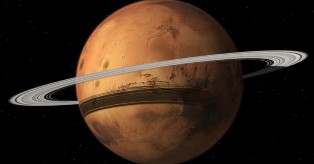
Mars to lose a moon and gets ring like Saturn

bySana Anwar
27/11/2015
in Science, Science & Technology
Share on FacebookShare on Twitter

EUROPE: Mars’ largest moon Phobos is slowly falling towards the planet and is likely to be shredded into pieces that will be strewn about the red planet in a ring like those encircling Saturn and Jupiter, scientists say.

Though inevitable, the demise of Phobos is not happening anytime soon. It will probably happen in 20-40 million years, leaving a ring that will persist for anywhere from one million to 100 million years, say scientists at the University of California, Berkeley.


You might also like

Tesla driverless system to use updated radar technology

12/09/2016

Apple to develop its own self-driving technology

10/09/2016

UC Berkeley postdoctoral fellow Benjamin Black and graduate student Tushar Mittal estimate the cohesiveness of Phobos and conclude that it is insufficient to resist the tidal forces that will pull it apart when it gets closer to Mars.

Just as Earth’s moon pulls on the planet in different directions, raising tides in the oceans, for example, so too Mars tugs differently on different parts of Phobos. As Phobos gets closer to the planet, the tugs are enough to actually pull the moon apart, the scientists say.

This is because Phobos is highly fractured, with lots of pores and rubble. Dismembering it is analogous to pulling apart a granola bar, Mr. Black said, scattering crumbs and chunks everywhere.

The resulting rubble from Phobos — rocks of various sizes and a lot of dust — would continue to orbit Mars and quickly distribute themselves around the planet in a ring. While the largest chunks would eventually spiral into the planet and collide at a grazing angle to produce egg-shaped craters, the majority of the debris would circle the planet for millions of years until these pieces drop onto the planet .


Related Stories

Tesla driverless system to use updated radar technology

byCT Report
12/09/2016

WASHINGTON: Electric carmaker Tesla announced Sunday it was upgrading its Autopilot software to use more advanced radar technology. In a...

Apple to develop its own self-driving technology

byCT Report
10/09/2016

SAN FRANCISCO: Apple may not become an automaker, but it still wants to develop its own self-driving technology. The iPhone-maker's...

NASA spots slowest known magnetar

byCT Report
10/09/2016

WASHINGTON: Astronomers have found evidence of a magnetar - magnetised neutron star - that spins much slower than the slowest...

‘YouTubers’ outshining old-school television

byCT Report
09/08/2016

SAN FRANCISCO: A media revolution is taking place, and most people over 35 years of age aren’t tuned in. Millennial...

Next Post

Sony confirms its working on official Remote Play application for PC/Mac

  • Terms and Conditions
  • Disclaimer

© 2011 Customs Today -World's first newspaper on customs. Customs Today.

No Result
View All Result
  • Transfers and Postings
  • Latest News
  • Karachi
  • Islamabad
  • Lahore
  • National
  • Chambers & Associations
  • Business
  • About Us

© 2011 Customs Today -World's first newspaper on customs. Customs Today.