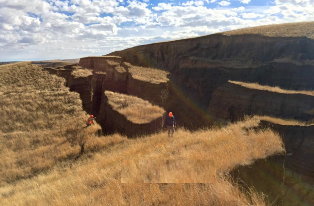
HONG KONG: The massive crack which formed in the Bighorn Mountains of Wyoming may have been caused by a slow-moving landslide and may possibly expand bigger, a geologist suggested.
Seth Wittke from the Wyoming Geological Survey said that from what he had seen and deduced from pictures, the phenomenon may have been the result of a slow-moving landslide which was prompted by underground lubrication. In this case, it may have been affected by a spring.


“The crack may get larger as long as there’s room for it to move it could keep moving,” Wittke said
Chamois Andersen, spokesperson for the same group, said that any assessment will be uncertain unless the area is inspected firsthand, but the geologists will have to get the approval of the landowner before going to the foothills of the mountain.
The crack can be found within 10 miles south from the town of Ten Sleep in Washakie County, Wyoming, and experts have estimated that about 15 to 20 million yards (8500 to 11300 miles) of movement have occurred. The gash is believed to be about 50 yards (0.03 miles) wide and 750 yards (0.4 miles) long.
Geologists advise the public not to go near the site because it is considered active and unsafe.
An engineer from Riverton, Wyoming has initially inspected the area, according to hunting company SNS Outfitter & Guides. The engineer said that the crack may have been caused by a wet spring that lubricated across a cap rock.
However, according to Dave Petley of the American Geophysical Union, the wet spring may have played a role but the phenomenon was not a sudden occurrence.