Customs Today
  • Home
  • Islamabad
  • Karachi
  • Lahore
  • National
  • Transfers and Postings
  • Chambers & Associations
  • Business
No Result
View All Result
Customs Today
  • Home
  • Islamabad
  • Karachi
  • Lahore
  • National
  • Transfers and Postings
  • Chambers & Associations
  • Business
No Result
View All Result
Customs Today
No Result
View All Result
Home Science & Technology Science

Massive dark matter found in nearby dwarf galaxy

bySana Anwar
19/11/2015
in Science, Science & Technology
Share on FacebookShare on Twitter

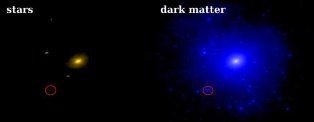
HONG KONG: Dark matter is called “dark” for a good reason. Although they outnumber particles of regular matter by more than a factor of 10, particles of dark matter are elusive. Their existence is inferred by their gravitational influence in galaxies, but no one has ever directly observed signals from dark matter. Now, by measuring the mass of a nearby dwarf galaxy called Triangulum II, Assistant Professor of Astronomy Evan Kirby may have found the highest concentration of dark matter in any known galaxy.

Triangulum II is a small, faint galaxy at the edge of the Milky Way, made up of only about 1,000 stars. Kirby measured the mass of Triangulum II by examining the velocity of six stars whipping around the galaxy’s center. “The galaxy is challenging to look at,” he says. “Only six of its stars were luminous enough to see with the Keck telescope.” By measuring these stars’ velocity, Kirby could infer the gravitational force exerted on the stars and thereby determine the mass of the galaxy.


You might also like

Tesla driverless system to use updated radar technology

12/09/2016

Apple to develop its own self-driving technology

10/09/2016

“The total mass I measured was much, much greater than the mass of the total number of stars—implying that there’s a ton of densely packed dark matter contributing to the total mass,” Kirby says. “The ratio of dark matter to luminous matter is the highest of any galaxy we know. After I had made my measurements, I was just thinking—wow.”

Triangulum II could thus become a leading candidate for efforts to directly detect the signatures of dark matter. Certain particles of dark matter, called supersymmetric WIMPs (weakly interacting massive particles), will annihilate one another upon colliding and produce gamma rays that can then be detected from Earth.


Related Stories

Tesla driverless system to use updated radar technology

byCT Report
12/09/2016

WASHINGTON: Electric carmaker Tesla announced Sunday it was upgrading its Autopilot software to use more advanced radar technology. In a...

Apple to develop its own self-driving technology

byCT Report
10/09/2016

SAN FRANCISCO: Apple may not become an automaker, but it still wants to develop its own self-driving technology. The iPhone-maker's...

NASA spots slowest known magnetar

byCT Report
10/09/2016

WASHINGTON: Astronomers have found evidence of a magnetar - magnetised neutron star - that spins much slower than the slowest...

‘YouTubers’ outshining old-school television

byCT Report
09/08/2016

SAN FRANCISCO: A media revolution is taking place, and most people over 35 years of age aren’t tuned in. Millennial...

Next Post

South Sudan to boost oil output to increase revenue

  • Terms and Conditions
  • Disclaimer

© 2011 Customs Today -World's first newspaper on customs. Customs Today.

No Result
View All Result
  • Transfers and Postings
  • Latest News
  • Karachi
  • Islamabad
  • Lahore
  • National
  • Chambers & Associations
  • Business
  • About Us

© 2011 Customs Today -World's first newspaper on customs. Customs Today.