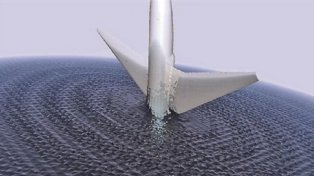


WASHINGTON: The Malaysia Airlines Flight MH370, which went missing more than a year ago, may have nosedived into the southern Indian Ocean, smoothly entering the water with the fuselage intact, according to a new study.
Computer simulations lead to the forensic assertion that a 90-degree nosedive explains the lack of debris or spilled oil in the water near where the plane is presumed to have crashed, researchers said, shedding light on one of the greatest aviation mysteries.
The team led by mathematician Goong Chen from Texas A&M University at Qatar used applied mathematics and computational fluid dynamics to conduct numerical simulations on the RAAD Supercomputer of a Boeing 777 plunging into the ocean.
The team simulated five different scenarios. In the study published in the journal Notices of the American Mathematical Society, Chen said based on all available evidence — especially the lack of floating debris or oil spills near the area of the presumed crash — the most likely theory is that the plane entered the water at a vertical or steep angle.

Karachi Port sets 138-year cargo handling record
KARACHI: Pakistan's maritime sector has achieved a major milestone as Karachi Port set a new record in its 138-year history...