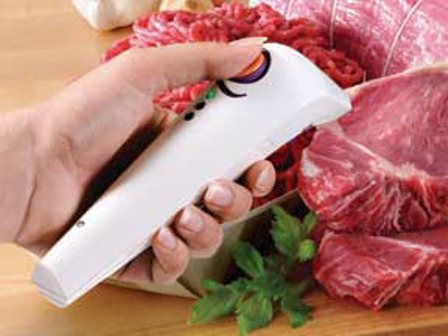
NEW YORK: Scientists at MIT have created a cheap, portable sensor that can tell you when meat or fish in your fridge or at the grocery store is safe to eat by detecting the gases emitted when it starts to rot. You would be able to take this device to the shops and decide for yourself what is safe to consume.
Timothy Swager, the John D. MacArthur Professor of Chemistry at MIT, says the sensor consists of chemically-modified carbon nanotubes. They could be deployed in “smart packaging” that would provide much more accurate, relevant and reliable data than the current system of displaying an expiry date.
You might also like


The sensor would also significantly reduce food waste. “People are constantly throwing things out that probably aren’t bad,” said Prof. Swager.
Senior author, Prof. Swager and colleagues wrote about the new sensor in the academic journal Angewandte Chemie (citation below). Graduate student Sophie Liu is the paper’s lead author. Other authors include postdoc Graham Sazama and lab technician Alexander Petty.
The meat sensor is similar to other carbon nanotube devices that Swager’s laboratory has developed in recent years, including one that can tell you how ripe a fruit is.