

Customs Today
  • Home
  • Islamabad
  • Karachi
  • Lahore
  • National
  • Transfers and Postings
  • Chambers & Associations
  • Business
No Result
View All Result
Customs Today
  • Home
  • Islamabad
  • Karachi
  • Lahore
  • National
  • Transfers and Postings
  • Chambers & Associations
  • Business
No Result
View All Result
Customs Today
No Result
View All Result
Home Science & Technology Science

Moon’s surface dissolves similar to the way sinkholes form on Earth

byCustoms Today Report
22/06/2015
in Science, Science & Technology
Share on FacebookShare on Twitter

You might also like

Tesla driverless system to use updated radar technology

12/09/2016

Apple to develop its own self-driving technology

10/09/2016

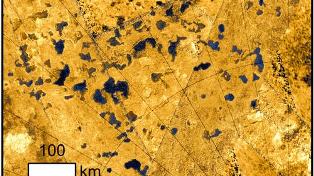
MEXICO: Saturn’s moon Titan is the only body in the solar system known to have lakes and seas on its surface. A new study may show how these holes formed on the moon’s surface.
A study using data from NASA and European Space Agency’s Cassini spacecraft indicates the moon’s surface dissolves similar to the way sinkholes form on Earth. Because of Titan’s cold temperatures- negative 292 degrees- the lakes are filled with liquid methane and ethane, not water. On Earth, sinkholes form due to erosion of dissolvable rocks like limestone.
Scientist at ESA determined how long it would take for areas of Titan’s surface to dissolve to create the sinkhole like features. Using Cassini data of Titan’s climate they found it would take about 50 million years to create a 300-foot hole on Titan’s surface.
“We found that the dissolution process occurs on Titan some 30 times slower than on Earth due to the longer length of Titan’s year and the fact it only rains during Titan summer,” said Thomas Cornet, lead ESA scientist for the study. “Nonetheless, we believe that dissolution is a major cause of landscape evolution on Titan and could be the origin of its lakes.”
Cassini recently completed a flyby of another Saturn moon on June 16 and sent back images of Dione’s rugged surface. In August the spacecraft will make a final flyby of Dione, dropping to within 295 miles of the moon. Later this year Cassini will begin preparation for its final mission to dive though the space between Saturn and its rings.

Related Stories

Tesla driverless system to use updated radar technology

byCT Report
12/09/2016

WASHINGTON: Electric carmaker Tesla announced Sunday it was upgrading its Autopilot software to use more advanced radar technology. In a...

Apple to develop its own self-driving technology

byCT Report
10/09/2016

SAN FRANCISCO: Apple may not become an automaker, but it still wants to develop its own self-driving technology. The iPhone-maker's...

NASA spots slowest known magnetar

byCT Report
10/09/2016

WASHINGTON: Astronomers have found evidence of a magnetar - magnetised neutron star - that spins much slower than the slowest...

‘YouTubers’ outshining old-school television

byCT Report
09/08/2016

SAN FRANCISCO: A media revolution is taking place, and most people over 35 years of age aren’t tuned in. Millennial...

Next Post

US customs arrests 2 from boat in smuggling case

  • Terms and Conditions
  • Disclaimer

© 2011 Customs Today -World's first newspaper on customs. Customs Today.

No Result
View All Result
  • Transfers and Postings
  • Latest News
  • Karachi
  • Islamabad
  • Lahore
  • National
  • Chambers & Associations
  • Business
  • About Us

© 2011 Customs Today -World's first newspaper on customs. Customs Today.