

Customs Today
  • Home
  • Islamabad
  • Karachi
  • Lahore
  • National
  • Transfers and Postings
  • Chambers & Associations
  • Business
No Result
View All Result
Customs Today
  • Home
  • Islamabad
  • Karachi
  • Lahore
  • National
  • Transfers and Postings
  • Chambers & Associations
  • Business
No Result
View All Result
Customs Today
No Result
View All Result
Home Science & Technology Science

Motor proteins prefer slow, steady movement: Rice University researchers

byCustoms Today Report
25/02/2015
in Science, Science & Technology
Share on FacebookShare on Twitter

You might also like

Tesla driverless system to use updated radar technology

12/09/2016

Apple to develop its own self-driving technology

10/09/2016

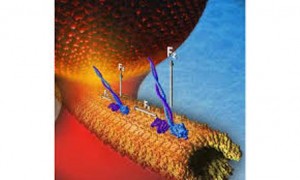
WASHINGTON: Rice University researchers are modeling the movement of motor proteins along a microtubule by breaking the pathway down into its basic elements.
The study suggests that the collective behavior of motor proteins like kinesins keeps cellular transport systems robust by favoring slow and steady over maximum movement.
The interactions once thought to be of little relevance are worthy of further study, according to Rice theoretical biophysicist Anatoly Kolomeisky. Small changes that may be controlled with medications can have a large effect on cell dynamics, an important consideration in treating disease, he said.
His group’s paper in the Journal of Physics A: Mathematical and Theoretical describes a new theoretical approach to study the effect of intermolecular interactions on the dynamics of motor proteins that move along cytoskeletal filaments known as microtubules.
Motor proteins powered by adenosine triphosphate, which supplies chemical energy, “walk” along microtubules to deliver cargo throughout cells and discard trash. Previous work by Kolomeisky and his students showed how microtubules are continually built, destroyed and rebuilt by cells that reuse the molecular building blocks like Legos.
The new mathematical model built by lead author Hamid Telmouri and co-author Kareem Mehrabiani, both Rice graduate students, analyzes short sequences of those blocks to demonstrate that both strong and weak interactions are important to regulate the flux, or movement, of motor proteins.

Related Stories

Tesla driverless system to use updated radar technology

byCT Report
12/09/2016

WASHINGTON: Electric carmaker Tesla announced Sunday it was upgrading its Autopilot software to use more advanced radar technology. In a...

Apple to develop its own self-driving technology

byCT Report
10/09/2016

SAN FRANCISCO: Apple may not become an automaker, but it still wants to develop its own self-driving technology. The iPhone-maker's...

NASA spots slowest known magnetar

byCT Report
10/09/2016

WASHINGTON: Astronomers have found evidence of a magnetar - magnetised neutron star - that spins much slower than the slowest...

‘YouTubers’ outshining old-school television

byCT Report
09/08/2016

SAN FRANCISCO: A media revolution is taking place, and most people over 35 years of age aren’t tuned in. Millennial...

Next Post

S Korea-Singapore port project costs $646m

  • Terms and Conditions
  • Disclaimer

© 2011 Customs Today -World's first newspaper on customs. Customs Today.

No Result
View All Result
  • Transfers and Postings
  • Latest News
  • Karachi
  • Islamabad
  • Lahore
  • National
  • Chambers & Associations
  • Business
  • About Us

© 2011 Customs Today -World's first newspaper on customs. Customs Today.